Boyd and William Alexander
Fact File: Boyd and William Alexander
Claim Number: 995
Compensation: £3679 6S 5D
Number of Enslaved in Claim: 153
Parish: Union Estate, Carriacou
Parliamentary Papers: p. 312
Boyd Life Dates: 1796-1861
William Life Dates: 1790-1853
We pick up their story in Paisley, Scotland in 1413, when Richard Alexander appears in the records as a lawyer and the feu superior of Paisley Abbey. His legal training and authority placed him among the notable men of his time, and the family’s role as feu superiors continued for centuries. The Alexanders held this position until the mid-1700s, when shifting fortunes and opportunities drew them away from Paisley towards the lands of Southbar at Erskine. These early centuries formed the bedrock of a family that would later leave its mark on Scotland, India, and even the literary history of Robert Burns.
It was Claud Alexander of Southbar, however, who propelled the family into a new era. Entering the service of the East India Company, he rose to become Paymaster General, a post of significant responsibility. The wealth he accumulated in India enabled him, on his return home, to purchase the Ballochmyle House and Estate in 1776. At that time Ballochmyle was considerably larger than today, and although the house had not yet grown to its later Victorian scale, it was a handsome and admired residence.
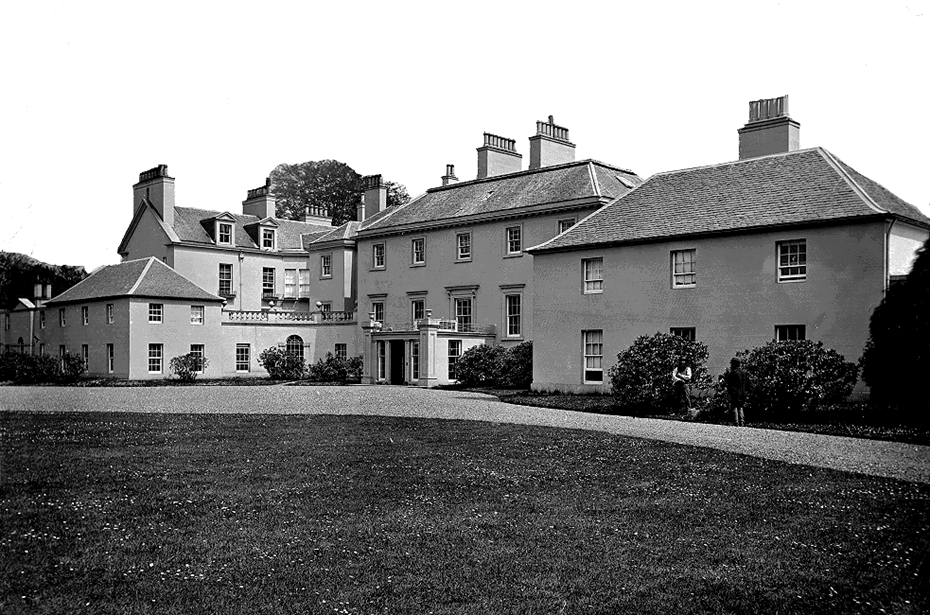
Ballochmyle House before 1887, when the building was completely redesigned. Photo taken from https://www.ayrshirehistory.com/mauchline_ballochmyle_old_house.html
The estate had previously belonged to the Whiteford family, who had been financially ruined by the catastrophic collapse of the Ayr Bank. Their misfortune coincided with a poignant literary episode: Robert Burns had penned “The Bonny Lass of Ballochmyle” for Miss Whiteford but was unable to deliver it before she left the estate. When Claud became laird, Burns redirected the poem and a letter to Wilhelmina Alexander, Claud’s sister. Wilhelmina was charmed, though Claud himself was far from pleased. Wilhelmina eventually moved to London, faded from local memory, and died there; her burial place remains unknown.
Claud, the first Alexander laird of Ballochmyle, had three sons with Helenora nee Maxwell: Claud, William Maxwell and Boyd.
Claud Alexander (1789–1845),
Claud Junior inherited aspects of his father’s entrepreneurial and administrative spirit. He was involved in the family's business and mercantile ventures. See digital image.
William Maxwell Alexander (1790–1853)
William trained as an architect, became laird of Ballochmyle at a moment of major infrastructural change. When the Glasgow Dumfries and South West Railway Company sought to cut a line through Mauchline, William Maxwell resisted until he personally approved the design of what became the striking Ballochmyle Viaduct. Preliminary work began in 1846. William Maxwell also inherited his father’s social reforming instinct: together with the pioneering industrialist David Dale, he helped build the village of Catrine, conceived as a model industrial community.
Boyd ALEXANDER (1796-1861)
Boyd was part of a prominent family with notable ties to both commerce and British colonial interests. He was a London-based merchant involved in the West India trade during the early 19th century. He was a partner in the firm Hon. William Fraser, Alexander & Co., together with his brother William which played a significant role as mortgagees of "slave-property." This indicates that the firm held financial stakes in estates or assets tied to slavery, a common practice in that era, especially for firms involved in the Caribbean, where enslaved labour was integral to plantation economies.
Through the partnership, Boyd had substantial interests in the slave trade outside of Grenada. He also owned estates and claimed compensation for estates in Antigua, St Vincent and Trinidad & Tobago. The partnership was ranked fourteenth among the merchant houses receiving compensation in 1834.
Boyd was also a proprietor of the American Land Company in 1835, indicating his investments extended beyond the West Indies into American property. This company appears to have been related to land speculation in the United States, another common pursuit for wealthy British merchants at the time.
Family
In terms of his personal life, Boyd married Sophia Elizabeth Hobhouse, the daughter of Sir Benjamin Hobhouse, 1st Baronet, in 1828. They had six children between 1831 and 1839, and in the 1840s, the family was living in Hanover Terrace, Westminster, London.
Boyd’s family continued to have an aristocratic lineage, with his son, Major-General Sir Claud Alexander, becoming the 1st Baronet, and his grandson Sir Claud Alexander, 2nd Baronet, continuing the line. The family's influence persisted well into the 20th century.
Boyd’s Descendants Major-General Sir Claud Alexander
Claud, son of Boyd Alexander, embarked on a distinguished military career. He fought in the Crimean War, later rising to become a Major General in the Grenadier Guards. Beyond his military standing, he entered public life and served for ten years as Member of Parliament for South Ayrshire. His wife had a vision for Ballochmyle that exceeded even the elegance of the original house. Finding it too small for their growing family and social obligations, she commissioned a major expansion. The transformation culminated in 1887, producing the grand Victorian house known until recent decades.
Sir Claud Alexander, 2nd Baronet (-1947)
Claud moved away from Ballochmyle House around 1900 and carved an unusual and respected path as a zoologist. His passion for animals led him to keep an extensive collection, even a small zoo of his own. Ballochmyle House, no longer the family’s main residence, was rented out until 1938, when it was sold to the Scottish Home and Health Department and became Ballochmyle Hospital.
Wilfred Alexander
Wilfred entered the diplomatic service and became British Consul in Beijing. It was there, inside the British Embassy, that his son,later Sir Claud Hagart-Alexander was born. Tragedy struck early: Wilfred died from an unidentified "Oriental fever" while serving in Beijing. Widowed and with three young children, Sir Claud’s mother brought the family back to Britain during his infancy.
Sir Claud Hagart-Alexander
When Sir Claud Alexander, 2nd Baronet died in 1947, the title of Laird of Ballochmyle passed to Sir Claud Hagart-Alexander, though the estate itself had by then long left the family’s possession. His life became both a custodian’s memory of a great heritage and the continuation of a lineage that had travelled from medieval Paisley to imperial India, from Burns country to Beijing.
Boyd and William’s interest in Grenada
Boyd Alexander and William Maxwell Alexander became involved in Grenada Claim No. 955 not as enslavers or estate owners, but as creditors of the estate’s proprietor, Rev. Peter William Pegus. Their role arose entirely from a financial relationship rather than any direct connection to the management of Union Estate in Carriacou or to the people who were enslaved there. They do not appear in the slave registers.
According to the key document T71/880, the Alexanders together with Hon. William Fraser, Claud Neilson and Hugh Hyndman had secured a legal judgment against Rev. Peter William Pegus on 27 April 1835 for the sum of £1,664 7s 6d. They also held a legal claim for a further £1,250 in advances, and had already lodged an earlier counterclaim for £832 3s 9d. These sums together created a total debt of £2,082 3s 9d owed to them by Pegus. When Pegus submitted his claim as the owner in fee of the enslaved people on Union Estate, the creditors counterclaimed for their outstanding debts. Pegus did not dispute the counterclaim and formally admitted that the money was owed, allowing the creditors to receive the portion of the compensation fund that corresponded to their judgment.
Errors in the Parliamentary Papers complicated the picture. The published volume incorrectly inflated the creditors’ award to £3,082 3s 9d and mistakenly merged the names of Boyd Alexander and Hugh Hyndman into a fictitious individual, “Alex. Hugh Hyndman Boyd.” The accurate record, however, is preserved in the original register T71/880, which confirms that the group received £2,082 3s 9d, while Rev. Pegus retained £1,597 2s 8d of the compensation. The enslaved people themselves had been formally registered in 1834 by Lewis Hoyes, acting as Pegus’s agent, as recorded in T71/328.
The Alexanders’ involvement reflects a familiar pattern in the financial structures of British Caribbean slavery. Wealthy Scottish and English families often became entangled in the plantation economy as lenders, mortgage holders and securities creditors, even when they had no direct role in plantation ownership. Their money circulated through London’s commercial networks, which routinely financed estates in the Caribbean. Boyd and William Maxwell Alexander, coming from a well-connected Scottish family with London interests, fit squarely within this wider financial ecosystem. Their presence in the claim demonstrates how deeply slavery’s economic reach extended into British society, drawing in individuals who may never have set foot in the Caribbean but nevertheless profited from the system through the enforcement of debts tied to enslaved people.
Boyd’s Compensation claims
Boyd Alexander emerged as a significant compensation awardee across the Caribbean. His claims show him operating primarily as a mortgagee and judgment creditor, revealing the breadth of his entanglement in the financial infrastructure of slavery rather than in day-to-day plantation management.
A mortgagee was a lender who had advanced money to an estate owner and taken a mortgage as security. In the Caribbean plantation economy, that security almost always included land, buildings, crops, and enslaved people, who were treated in law as property. If the owner defaulted or became insolvent, the mortgagee had a legal claim on the estate’s value. When the British government paid compensation for the loss of enslaved “property,” mortgagees were recognised as having a prior or shared right to that compensation, because their loans had been secured on enslaved labour. This meant that compensation money could be paid directly to a mortgagee rather than to the resident owner.
A judgment creditor was someone who had gone further than holding a debt or mortgage and had successfully sued the debtor in court. Once a court issued a judgment confirming that a specific sum was owed, the creditor gained the right to enforce repayment. In the compensation context, this allowed judgment creditors to lodge counterclaims against emancipation awards. If the court judgment pre-dated the compensation decision and was accepted by the Commission, the judgment creditor could intercept part or all of the compensation before it reached the estate owner.
Grenada Compensation Claim
Boyd was as an awardee and judgment creditor for the Union Estate, Carriacou (Claim No. 955 ). Here, compensation associated with 153 enslaved people, amounting in the Parliamentary Papers to £3,679 6s 5d, was subject to a complex division between the estate owner, Rev. Peter William Pegus, and Pegus’s creditors.
Rev. Peter William Pegus appeared before the Compensation Commission as owner-in-fee of 153 enslaved people. Those enslaved people had been formally registered in 1834 by Lewis Hoyes, Pegus’s local agent, which established Pegus’s legal title at the moment of emancipation. On that basis, Pegus submitted the primary compensation claim, assessed at £3,679 6s 5d.
However, Pegus did not have an unfettered right to that money. By the time compensation was being processed, he was already heavily indebted. Boyd Alexander, together with William Maxwell Alexander, Hon. William Fraser, Claud Neilson and Hugh Hyndman, had obtained a court judgment dated 27 April 1835 against Pegus. That judgment confirmed that Pegus owed them £1,664 7s 6d, and in addition they held a charge for further advances of £1,250. When combined with an earlier counterclaim of £832 3s 9d, the total sum legally owed to them amounted to £2,082 3s 9d.
Because this debt was legally established before compensation was finalised, Boyd Alexander and the other creditors were entitled to intervene. They lodged a counterclaim against Pegus’s compensation award, asserting their right to be paid first out of the compensation fund. Crucially, Pegus admitted the counterclaim. There was no dispute over the existence or validity of the debt, which meant the Compensation Commission accepted the creditors’ claim in full.
This is where Boyd Alexander’s role becomes clear. He received compensation because the British state’s payment for enslaved people was treated as an asset that could be seized to satisfy Pegus’s debts. Boyd Alexander’s financial interest in slavery at Union Estate therefore operated through credit and the courts, not through plantation management. This financial power allowed Boyd and his associates to extract value from enslavement without ever owning the estate or residing in Grenada.
The published Parliamentary Papers (p. 312) obscure this reality in two ways. First, they incorrectly state that the creditor group received £3,082 3s 9d, when the original register T71/880 shows that they received only £2,082 3s 9d. Second, they mistakenly collapse Boyd Alexander and Hugh Hyndman into a single individual, “Alex. Hugh Hyndman Boyd,” a clerical error that has caused long-standing confusion. The archival record makes clear that Boyd Alexander and Hugh Hyndman were separate men, each acting as judgment creditors.
Once the correction is applied, the financial outcome is straightforward. Of the total compensation for 153 enslaved people, £2,082 3s 9d was diverted to Boyd Alexander and his fellow creditors to satisfy Pegus’s debts, while £1,597 2s 8d was paid to Pegus himself as the residual owner-in-fee.
Compensation claims across the Caribbean
Boyd’s earliest recorded involvement appears to have been in Antigua, where he was an awardee as mortgagee on Yapton Farm (Claim No. 1045). In this case, compensation of £1,681 4s 1d was paid in respect of 113 enslaved people.
Boyd’s most extensive involvement was in St Vincent, where he appears repeatedly as an awardee, often explicitly described as mortgagee, across a cluster of estates. At Lot No. 14 Estate (Claim No. 451), he received £8,926 12s 3d in respect of 339 enslaved people, a very substantial claim reflecting heavy financial exposure.
He was similarly compensated as mortgagee for Montrose (Claim No. 574) with £2,993 13s 1d for 107 enslaved people, Golden Grove (Claim No. 599) with £3,101 19s 9d for 106 enslaved people, and Cheltenham on the island of Mustique (Claim No. 745) with £6,525 9s 0d relating to 257 enslaved people.
In addition to these mortgage-backed claims, Boyd Alexander also appears simply as awardee, without the mortgagee designation, on several St Vincent estates. These include Orange Hill (Claim No. 449B) with £3,363 5s 10d for 243 enslaved people, Waterloo Estate (Claim No. 450) with £7,856 11s 7d for 308 enslaved people, and Sion Hill (Claim No. 557) with £3,794 13s 7d for 139 enslaved people.
These entries suggest either direct financial entitlement or complex layered interests, but in all cases Boyd Alexander was recognised by the Compensation Commission as having a legitimate claim on the value of enslaved labour.
His involvement extended beyond the Eastern Caribbean into Trinidad, where he was an awardee on Clydesdale Cottage (Claims 1838A & B). There, compensation of £1,341 12s 9d was paid in respect of 26 enslaved people, marking a smaller but still significant financial interest in another colony newly absorbed into the British slave system.
Taken together, Boyd Alexander’s claims span Antigua, Grenada, St Vincent, Mustique and Trinidad, and are linked to at least ten estates and more than 1,800 enslaved people. The pattern is consistent: he functioned as a provider of capital, using mortgages, legal charges and court judgments to secure returns from plantation economies across the Caribbean. When slavery was abolished, the British state’s compensation scheme converted those human securities into cash, much of which flowed to absentee financiers like Boyd Alexander rather than resident planters.
Boyd Alexander’s compensation record illustrates with stark clarity how slavery’s profits were distributed through British financial networks. He did not need to own land or reside in the Caribbean to benefit materially from enslavement. Instead, his wealth was embedded in the system through credit, mortgages and legal enforcement, making him a direct beneficiary of emancipation compensation and a clear example of how the legacies of slavery reached deep into Scottish and metropolitan society.
That wealth helped to sustain the economic security and social standing of the Alexander family in Britain. Boyd’s financial success supported a lifestyle that included residence in Hanover Terrace, Westminster, marriage into the Hobhouse family (linking the Alexanders to baronetcies and political elites), and the ability to raise children with elite military, political and professional prospects. His son became Major-General Sir Claud Alexander, an MP and later a baronet. Subsequent generations moved easily into diplomacy, science, and public life. While Ballochmyle itself was originally purchased with East India Company wealth, the family’s continued prosperity in the nineteenth century was reinforced by capital extracted from Caribbean slavery and crystallised through compensation.
In this way, slavery helped the Alexander family consolidate wealth, status and influence across generations even though they were geographically distant from the day-to-day operations of the system. Their story exemplifies how slavery’s legacy extended deep into Scottish and metropolitan society, shaping elite families whose prosperity rested, in part, on the monetisation of enslaved lives.
Acknowledgements
We are grateful to Dr. John Angus Martin of the Grenada Genealogical and Historical Society Facebook group for his editorial support.
References
The Alexanders of Paisley https://issuu.com/cloudy242/docs/ckdec21/s/14196921
The Alexander Family of Ballochmyle
https://www.ayrshirehistory.com/mauchline_alexander_family_of_ballochmyle.html
Landed families of Britain and Ireland https://landedfamilies.blogspot.com/2013/10/85-alexander-later-hagart-alexander-of.html
http://thepeerage.com/p42924.htm
Slaves and Highlanders | Fraser (Ness Castle) (spanglefish.com)
Grenada 955 (Union Estate) https://www.ucl.ac.uk/lbs/claim/view/10810
Boyd Alexander. https://www.ucl.ac.uk/lbs/person/view/44579
