Frederick and Mary Aberdeen were a free coloured couple of modest means living on the Providence Estate in St Andrew, whose daily lives reflected the quiet stability and limited opportunities of Grenada’s small property-holding families in the years surrounding emancipation. They enslaved a girl called Reine. Her life was likely defined by domestic labour and carried the quiet endurance of someone entering womanhood as Grenada moved from enslavement to freedom.

Fact File: 

Claim Number: 803 

Compensation Award:  £34 8S 0D 

Number of Enslaved in Claim: 1 

Parish: St. Andrew 

Parliamentary Papers: p. 99 

------------------------------------------------------------------------- 

The Life of Frederick and Mary Aberdeen 

Frederick Aberdeen and his wife, Mary Angelique Aberdeen, were residents of the Providence Estate in the parish of St Andrew, Grenada. Records show that they lived on the estate during the final years of slavery and the transition into emancipation. They had a son Frederick Alexander ABERDEEN who was baptised on 12 Apr 1842 and the family were still on the estate at this time.  

Frederick’s profession is listed as a mason, confirming his status as a skilled tradesman, an occupation that would have been in demand during the period of rebuilding and social transition following emancipation. 

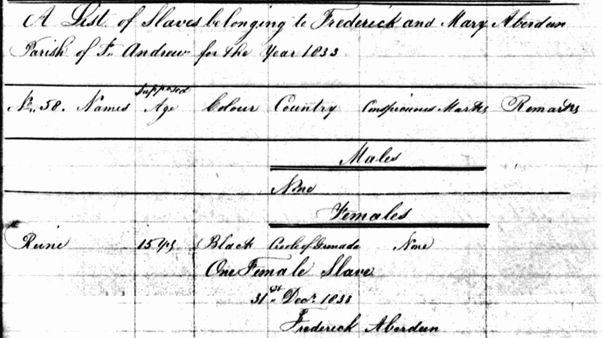
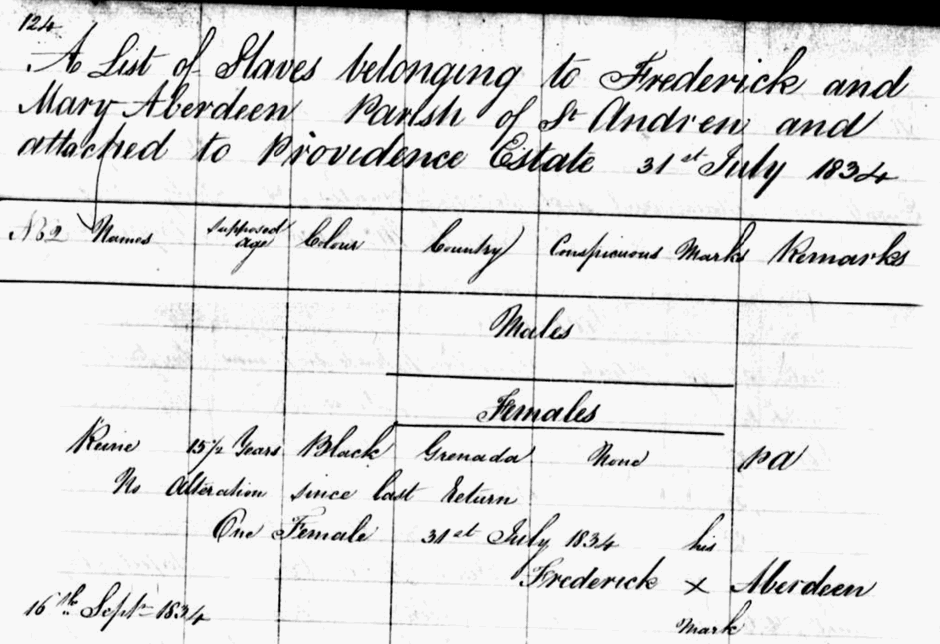
They jointly claimed compensation for the loss of their one enslaved worker called Reine who first appeared listed under their ownership in the 1833 slave register aged 15.  By placing a cross for his name on the register, this suggests that Fred was illiterate. 

Little else is known about the couple’s later lives although these records remind us that Grenada was not confined to large plantations but extended into households and skilled tradespeople who relied upon coerced labour. 

Frederick and Mary Aberdeen’s story is therefore one of ordinary people caught up in a system that advocated enslavement and, although working class, became beneficiaries of the compensation scheme. 

With little other information about the couple, we can speculate that the most likely ancestry for Frederick Aberdeen is that he was a free coloured man, likely of mixed African and European heritage. This conclusion comes from several clues in the historical record: the surname Aberdeen appears in Grenada most commonly among free coloured families rather than white planter dynasties; his occupation as a mason fits the pattern of skilled trades that were dominated by free coloured people in the early nineteenth century; and the fact that he and his wife enslaved only one young woman suggests a modest household rather than a large white-owned estate. Living on the Providence Estate rather than owning it also points to a free coloured working family rather than wealthy European-descended landowners. While we cannot be completely certain without a racial descriptor in the documents, the overall evidence strongly suggests that Frederick belonged to Grenada’s free coloured population. 

Frederick’s surname was probably inherited from an earlier enslaver or estate owner bearing the name Aberdeen, and he retained the name as he entered the free coloured community.  It is less likely to have come from a biological Scottish planter as there is no evidence of a large white Aberdeen planter family in St Andrew or even Grenada.   

Mary Angelique Aberdeen was also most likely a free coloured woman. Her life circumstances mirror Frederick’s in ways that point toward the same ancestry: she lived with him on Providence Estate as part of a modest free household, rather than as part of the white planter class, and together they enslaved only one young girl, which was a common pattern among free coloured families who held one or two domestic servants. 

Her marriage to Frederick, who himself appears strongly to have been a free coloured man, further supports this conclusion, as marriages in that period and community typically occurred within the same social and racial group. Although the records do not explicitly state her race, all contextual clues suggest that Mary Angelique was also part of Grenada’s free coloured population. 


Frederick Alexander ABERDEEN (1842-) 

Their son Frederick had a son with his wife, Elizabeth, born 3 May 1881 and baptised 6 days later in St. Andrew Ref 

There is a birth record recording the arrival of another son between them on 11 May 1884 in St. Andrew. By this time Elizabeth is registered as Elizabeth Aberdeen which confirms that the couple were married. Ref 

There are also marriage records of 3 other people born to a Frederick Aberdeen who could have been his children. Virginia (b.1871), Cornelius (b.1878) and Adrian Augustus (b.1887). There is a record that a Virginia Aberdeen had a daughter in St. Andrew in 1884. She would only have been 13 if it was the same person. 

------------------------------------------------------------------------- 


The Enslaved

1833 Slave Register 

The 1833 slave register shows that Frederick and Mary Aberdeen had one enslaved a girl named Reine.   Reine was born in Grenada and lived on the Providence Estate in St. Andrew, where she was probably born.      

  1834 Slave Register 

In the 1834 Slave Register, Reine was recorded as 15½ years old, still in their possession, and she remained with Frederick and Mary through the abolition period.

Reine was the only enslaved person in the Aberdeen household, which strongly suggests that her daily life was centred on domestic work: assisting Mary with cooking, laundry, cleaning, and other household duties, as well as running errands. In households that enslaved just one girl, the work was constant and wide-ranging, and girls like Reine were expected to be ever-present, obedient and industrious.

Her presence in the Aberdeens’ home also reflects the social structure of the time. Free coloured families of modest means frequently owned one or two enslaved people, often young girls whose labour provided essential support to the household. Reine’s life would therefore have been intimately entangled with the Aberdeens’ daily routines, expectations and demands.

Although the historical record does not tell us what became of her after 1834, her youth at the moment of abolition meant she would enter adulthood carrying the experiences of enslavement but with the possibility of shaping her own life in freedom.

That said, It is quite likely that Reine remained with the Aberdeens for at least a short period after emancipation, until she was old enough to establish her own household or employment. There is no record of her own family so there may have been no other option but to stay.

It is possible that she was not much younger than Mary Aberdeen who had Frederick Augustus Aberdeen in 1842. The Aberdeens were not wealthy and their limited means suggests they were unlikely to have suddenly employed another servant, making Reine’s continued presence valuable to them. Reine may have stayed on to support Mary as she was bringing up her family.  This would have given Reine stability, familiarity, and shelter while she navigated early adulthood in a changing society.

Reine’s story is a reminder that emancipation was lived not only on large plantations but also within small households, where the lives of young enslaved girls were tightly controlled yet often overlooked in official histories. Reine’s presence in the Aberdeens’ home illuminates both the vulnerability of enslaved children and the resilience required to navigate a world marked by inequality, coercion and profound change.

Acknowledgements

 We are grateful to Dr. John Angus Martin of the Grenada Genealogical and Historical Society Facebook group for his editorial support and Owen Hankey for content contributions.

The Aberdeens were a family of Scottish origin who became part of Grenada’s free coloured community, rising in status through property, public service and the manumission that reshaped their family line. The people they enslaved lived under coercion, sale, illness and constant uncertainty, yet their recorded lives reveal extraordinary resilience in the face of bondage.

Fact File: 

Fanny or Jane Aberdeen                            Barbara Aberdeen 

Claim Number: 274                                  Claim Number: 269 

Compensation:  £103 4S 1D                    Compensation: £20 12S 10D 

Number of Enslaved in Claim: 4             Number of Enslaved in Claim: 1 

Parish: St. Andrew                                   Parish: St. Patrick 

Parliamentary Papers: p. 96                    Parliamentary Papers: p. 96 

Life dates: d.1840                                      Life dates: 1797-1867 

------------------------------------------------------------------------- 

The story starts with…

The Life of Alexander Aberdeen (1771–1815)

Alexander Aberdeen was born in Echt near Aberdeen, Scotland, where he was baptised on 23 May 1771. He was the son of Thomas Aberdein (1738–1815) and Grizel “Grace” Harvie (1735–1825). Both came from long-established Aberdeenshire families whose roots stretched deep into the rural north-east of Scotland. His father, Thomas, was the son of William Aberdein (1705–1779) and Jean Snowie (1711–1790) of Echt, while his mother descended from the Harvie/Mackay line through John Harvey (1691–1767) and Elizabeth Mackay (1691–1776). The extended Aberdeen, Murray, Snawie, Edward, Gordoun and Forbes lines form a rich network of Scottish farming and artisan families, many of whom lived for generations around Midmar, Echt, and Old Aberdeen.

This ancestry places Alexander firmly within the eighteenth-century Scottish demographic that fed heavily into British colonial expansion. Young Scottish men often the sons of farmers, blacksmiths and craftsmen frequently travelled to Grenada and other islands in the Caribbean seeking opportunity as clerks, book-keepers, overseers, and small planters. Alexander followed this path sometime in the late eighteenth or early nineteenth century, joining a diaspora that would profoundly shape the social and economic world of the Grenada.

By the early 1800s, he had established himself as a planter in the parish of St Andrew, Grenada, with livestock, household goods and modest landholdings. He was literate, respected, and financially stable, moving within the circles of colonial administration and trade. Yet his personal life diverged in ways that reveal a complex and intimate connection to the people of Grenada.

In 1806, Alexander made a bold and unusual decision: he formally manumitted his “mulatto slave named Fanny”, freeing not only her but “all her future issue and increase.” Such language leaves little doubt that Fanny was his partner and that he intended to secure the legal and personal freedom of their children. This manumission placed Fanny and her existing or future children among the earliest free coloured families in Grenada nearly three decades before universal emancipation.


TRANSCRIPTION

Grenada Entered 21st October 1806

Know all Men by these Presents that I Alexander Aberdeen of the Island aforesaid, Esquire, for divers good Causes and Considerations me hereunto moving have manumitted enfranchised made free and from all ties of servitude absolved. And by these Presents do for myself my Heirs Executors and Administrators each and every of them manumit enfranchise and make free and from every tie of servitude absolve my mulatto Slave named Fanny and also all her future Issue and Increase, so that neither the said Alexander Aberdeen nor my Heirs Executors or Administrators or any or either of them shall from henceforth have claim challenge or demand any Right or Title by reason of any slavery or villainage in the said Fanny or her future Issue but that the said Fanny and her future Issue shall from henceforth for ever hereafter be as free to all Intents and Purposes whatsoever as any other Subject of His Majesty King George the Third.


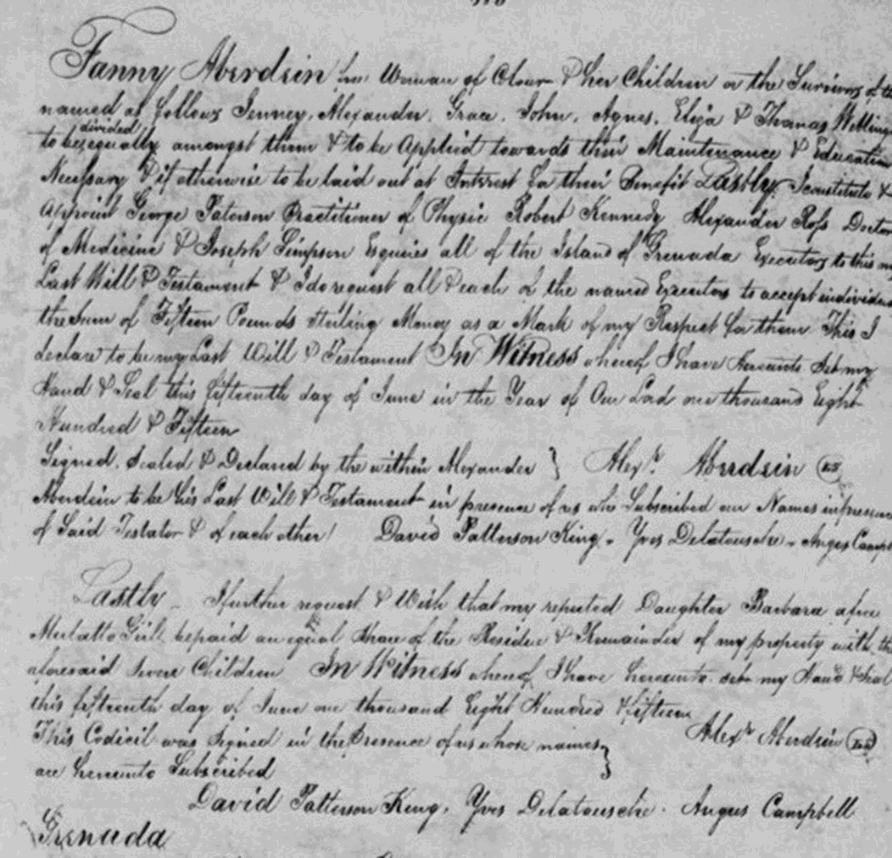
His will, written in 1815, confirms the depth of this relationship. In it, Alexander left everything, after settling debts to Fanny and her children: Jenny, Alexander, Grace, John, Agnes, Eliza and Thomas Hillington. He further acknowledged another daughter, Barbara Aberdeen, who he described as a free mulatto. This open recognition of a mixed-heritage family was unusual among Scottish planters of his time, many of whom fathered children from enslaved or formerly enslaved women but did not legally provide for them. Alexander’s choices ensured that his children would inherit property, security, and social legitimacy uncommon for people of mixed ancestry in the early nineteenth century.


TRANSCRIPTION

Grenada Entered 29th July 1815

In the Name of God Amen I, Alexander Aberdeen of the Island of Grenada, Parish of St Andrew, Planter, being of sound mind & Memory make this my last Will & Testament. First I Desire to be Decently buried but in a plain Manner & as little expense attending as is possible. Imprimis it is my intention that all Sums of Money due unto Me & also all my Personal property consisting of Household & Furniture Plate Horses Cattle & Sheep be applied as far as Necessary towards paying my Just & Lawful Debts. The residue & remainder of my Estate with all other properties & What Else is or may be Appertaining I give Devise & Bequeath to Fanny Aberdeen a Woman of Colour & her Children or their Survivors, viz. namely as follows, Jenny, Alexander, Grace, John, Agnes, Eliza and Thomas Hillington, & likewise any money there is to be applied towards their Maintenance & bringing of them up to be paid out of Interest for their benefit. Lastly, I Constitute & Appoint George Paterson, practitioner of Physic, Robert Kennedy, Alexander Rofs doctor of medicine and Joseph Simpson Esquire all of the Island of Grenada executors of this my Last Will and Testament and I do request all parties of the named executors to accept individually the sum of fifteen pounds sterling money as a mark of respect for them. This I declare to be my  Last Wills & Testament. In Witness whereof I have hereunto set my hand & Seal this fifteenth
day of June in the Year of Our Lord one thousand eight hundred & Fifteen.

Signed, Sealed & Declared by the within:
Alexander Aberdeen (LS) to be his Last Will and Testament in presence of us who subscribed our names in prescence of said testator and each other

David Patterson King
Yves Delatouche
Angus Campbell

Lastly, I further request and wish that my reputed Daughter Barbara a free mulatto girl
be paid an equal share of the Residue & Remainder of my property with the aforesaid seven children. 

In Witness whereof I have hereunto set my hand this fifteenth day of June 1815
in presence of the above witnesses; the Codicil was signed in the presence of us whose names are herunto subscribed.

David Patterson King
Yves Delatouche
Angus Campbell
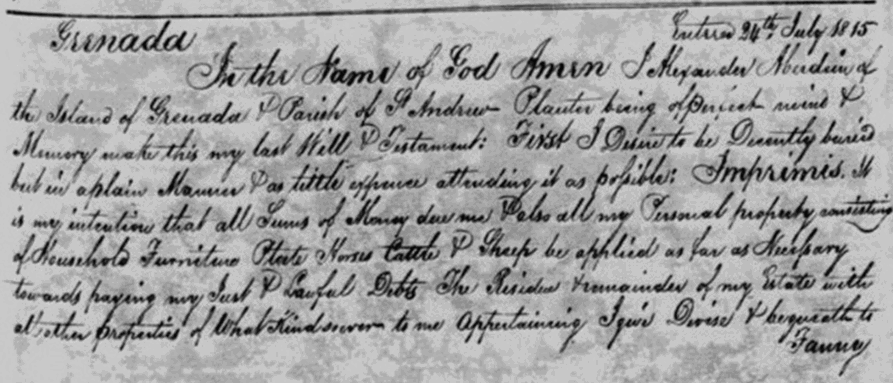

By making these provisions, Alexander ensured that his family formed part of Grenada’s emerging free coloured class that later became significant in Grenada’s social and political landscape.


His death was reported in the St Georges Chronicle and Grenada Gazette on July 5 1815.
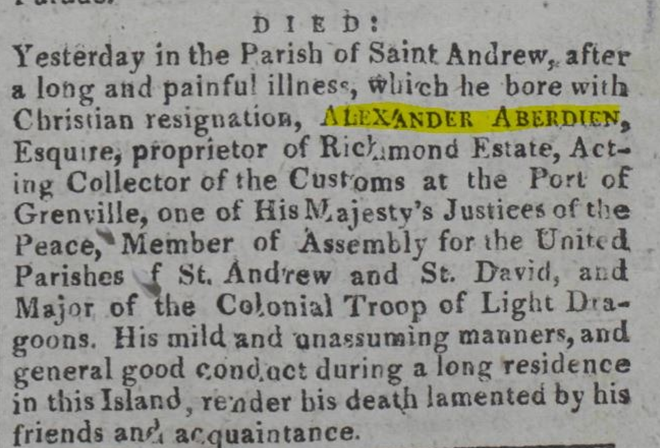


The Life of Fanny (or Jane) Aberdeen (-1840)

 Fanny Aberdeen, sometimes also recorded as Jane Aberdeen, was manumitted by Alexander Aberdeen in 1806 and named in his will with her children as a free woman of colour. Her children took his name and there is little doubt that Alexander was their father.  


Fanny’s life was deeply woven into the machinery of enslavement in early 19th-century Grenada. Over nearly two decades she appears consistently in the Slave Registers of St Andrew, buying, selling, managing, and reporting on the lives of the people she enslaved. Her long paper trail shows that she was an active participant in the system, acquiring people through purchase and Marshal’s sale, selling them on again, and acting as trustee for other proprietors.


Early Years in the Registers: 1817–1821 

Fanny first appears in the 1817 Slave Register with eight enslaved people: six African-born adults: Sandy, Neilson, Nancy, Lidia, Charlotte and Louisa (all in their 30s and 40s), and two five-year-old children, Billy and Alicia, who were born enslaved in Grenada.  Her reporting of Louisa’s death in 1819 reveals the harsh conditions they endured: Louisa died at 42 of “mal d’estomac,” a term used on Caribbean plantations for the fatal consequences of pica, the desperate practice of dirt-eating that enslaved Africans used as an act of bodily resistance or to cope with trauma.

 By 1821, Fanny was already participating in the slave market, selling Sandy, who had ben with her since at least 1817, to John Chapman. Despite confusion in the archival indexing, she was operating in St Andrew, Grenada and not Jamaica as stated incorrectly in the record.  


Expansion and High Turnover: 1822–1825

 From 1822 onwards, Fanny’s involvement intensified. She bought six more people from Julien Allan Delatouche, four of them African-born, and two, Bonette and Jean Rose, born in Grenada. Bonette was described as a mulatto girl of about eleven. Children of African and European descent were often highly valued for domestic labour. 

That same year she reported the deaths of Billy (age 9) and Charlotte (age 37), both from mal d’estomac, an indicator of profound distress among the enslaved. Still, acquisitions continued. The following year she sold Bella and Julie back to the Delatouche family and reported Nancy’s death, again from mal d’estomac.

In 1823, Fanny made further purchases. John, Rosette and little Frances while also signing as trustee for enslaved people owned by Sophia, Caroline and John Alexander. Her dual signature, sometimes as Jane, sometimes as Fanny, appears consistently across the records, confirming that both names referred to the same woman.

 In 1825 was still active: she reported the birth of another child, also named Frances, giving her a workforce of two men and seven women. She was simultaneously managing a second place, in her name Jane Aberdeen, where Rosette gave birth to Margaret. At this point she controlled enslaved people either directly or as trustee at three separate places.  


Decline and Consolidation: 1826–1830

The later 1820s show a pattern of reduction, sale, manumission, and re-adjustment. Lydia died in 1826. Several others; Breeche, Jean Rose and Renette (Bonette) were sold back to Delatouche. Lease and her child Eliza were sold in 1828; Susannah was manumitted that same year, and by 1829 Fanny had only two enslaved people left: Nelson and Alicia, who had been with her since childhood. 


But in 1830, she suddenly expanded again acquiring Fanny (23), Charles (7), David James (19 months) and baby George from a Marshal’s sale. These four were described as mulattoes and had been brought together as a family group. For a short time, her workforce rose to six.
  

Final Years of Enslavement: 1831–1834

 Her newly purchased teenager Felisha died at sixteen in 1831, once again from mal d’estomac. The following year Fanny sold the entire mulatto family group to Catherine Drysdale, reducing her holding to a single enslaved man. 


In 1833, Fanny’s affairs were administered not by her directly but by her son, John Aberdeen, acting as her agent, suggesting she was unable to appear in person. Nelson, then around 40, was the last person she held.


In 1834, Matthew Lumsden acted as her agent and reported Nelson’s death yet again attributed to mal d’estomac. With his death, the group of enslaved people directly under Fanny’s control came to an end.


Compensation and Death

 On 12 October 1835, Jane Aberdeen filed a claim for compensation for four formerly enslaved people. These were likely the individuals she managed as trustee on behalf of the Alexanders rather than her own. The compensation records confirm her continued involvement in the institution even after emancipation. 

Jane “Fanny” Aberdeen died on 23 September 1840, with a death notice published in the St George’s Chronicle on 3 October that year closing the life of a woman whose personal history mirrors the evolution, harsh nature and persistence of slavery in Grenada.



1846 Indenture
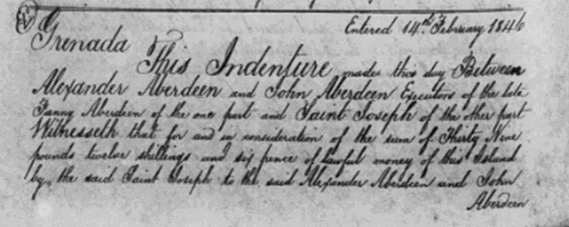


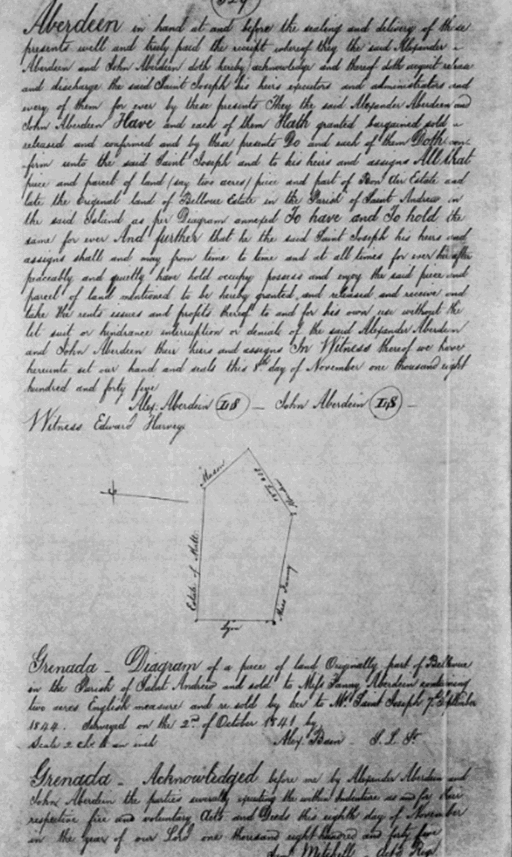
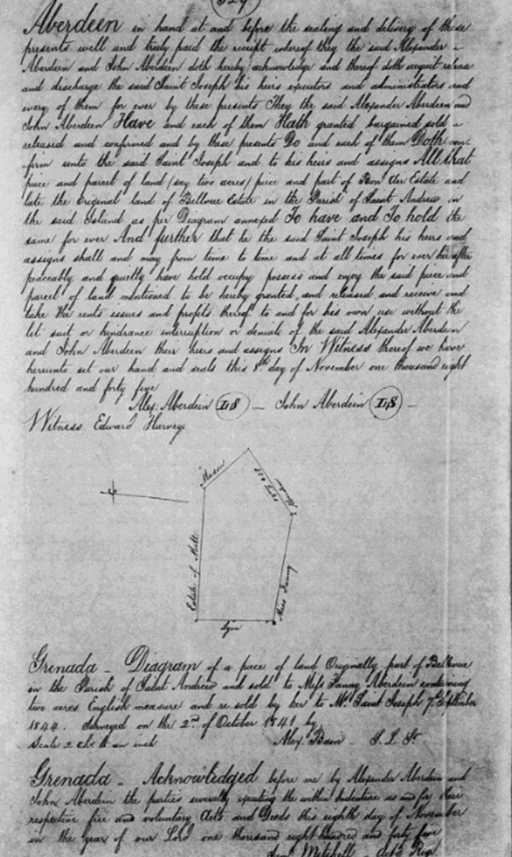
The indenture documents the sale and transfer of land in St Andrew, by John and Alexander Aberdeen acting as executors of the late Fanny Aberdeen. They are most likely her sons and it was John Aberdeen that handled her slave register in 1933. They acknowledge receiving the sum of thirty-nine pounds, twelve shillings and six pence from a man named Saint Joseph. This payment completed the sale of land formerly belonging to Fanny Aberdeen, forming part of the settlement of her estate after her death.

 It refers to forty-two acres, originally part of the Bellona Estate in the St. Andrew. A survey diagram was included in the original document. The indenture formally grants, sells, releases and confirms the land to Saint Joseph and guarantees that he and his heirs may hold, occupy and enjoy it permanently without interruption or dispute. The document is signed and sealed by Alexander and John Aberdeen and witnessed by Edward Harvey.


Alexander Aberdeen’s children

Of his children we note the following: 

The Life of Alexander Aberdeen (Junior) c1801-1875

 Alexander Aberdeen Junior was one of the most prominent members of Grenada’s free coloured community in the nineteenth century. Born in St Andrew in the first years of the 1800s, he was the son of Alexander Aberdeen, a Scottish-born planter from Echt, Aberdeenshire, and Fanny, a mixed-heritage woman whom his father had enslaved but later freed. 

In 1806, when Alexander Junior was still very young, his father executed a formal deed of manumission freeing Fanny and “all her future issue,” which meant that Alexander Junior was legally free decades before the emancipation of enslaved people in the British colonies. When his father died in 1815, he named Fanny and all their children as his heirs. Alexander Junior therefore grew up in the rare position of being a free, property-connected person of colour in early nineteenth-century Grenada, at a time when such status provided crucial stability and opportunity. 

As he reached adulthood, Alexander Aberdeen Junior established himself in St George’s and began his working life as a book-keeper in several commercial firms. 

This occupation was typical for free coloured and mixed-heritage men whose literacy and numeracy allowed them to move into clerical work rather than the manual labour expected of the enslaved. 

Over time he gained the confidence of the colonial administration and was appointed Clerk of the Market in St George’s, a post that required daily supervision of trading practices, prices, weights and measures. 

By the late 1830s Alexander Junior was sufficiently recognised to appear in official notices, such as the 1839 issue of The Grenada Free Press, which lists an “Alexander Aberdeen, Gentleman” as appointed to the post of Ensign in the St George’s Regiment. This was a commissioned junior officer rank. Although militia appointments often carried local political weight rather than military significance, they nonetheless signalled standing, respectability and acceptance among Grenada’s middle class.
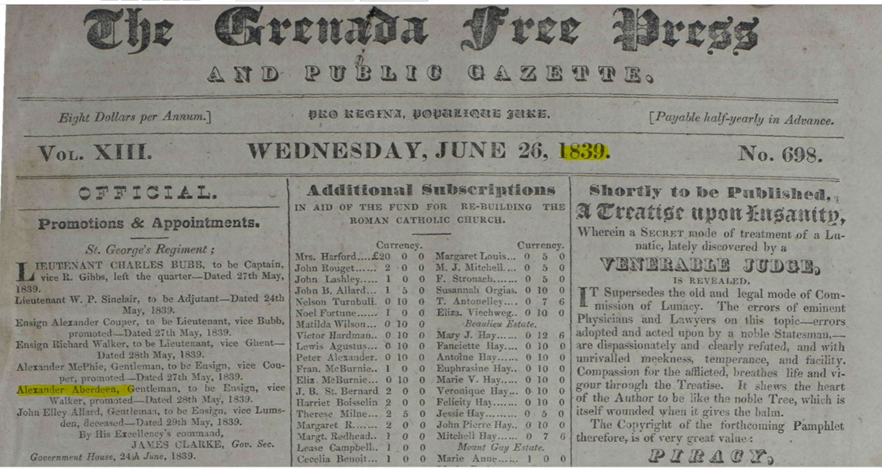

 Alexander Aberdeen Junior established himself as a literate and respected free coloured man within Grenada. He had grown up with a status that was unusual for someone of mixed descent in the early nineteenth century, having been freed along with his mother Fanny by his father in 1806. His later life demonstrates that he was relied upon for administrative and clerical responsibilities. 

After his mother died, he was responsible for finalising the legal transfer of her property together with his brother John Aberdeen as executors of an indenture made on 11 February 1846. He was involved in ensuring that the land previously belonging to the deceased Fanny Aberdeen, could be lawfully conveyed to the purchaser, Saint Joseph. His participation indicates that he occupied a recognised position within family and local networks, responsible for executing legal formalities and safeguarding the proper transfer of title.  His presence in this indenture is consistent with the reputation later described in his obituary of 1875, in which he is remembered as dependable, honest, and trusted in public matters. 

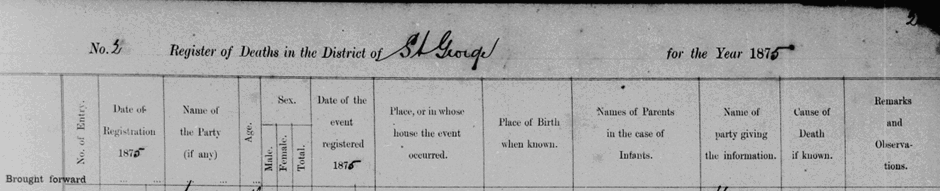
Alexander Aberdeen Junior lived a long life, reaching the age of seventy-four. He died on 3 October 1875 at his residence at Monckton Street, St George’s, after what the obituary described as a short illness although his death record indicates some sort of poisoning. 
 His obituary records that he later served as Treasurer of the Society for the Education of the Poor, an important charitable institution. His roles placed him squarely within the civic life of the town and testify to the trust placed in him by both the government and the community.  He was also remembered as “honest, industrious and good-hearted,” a man agreeable in temper and respected for his “sterling qualities.” He appears to have been well known, with a large number of friends and relatives present at his funeral in the burial ground at Hospital Hill. 
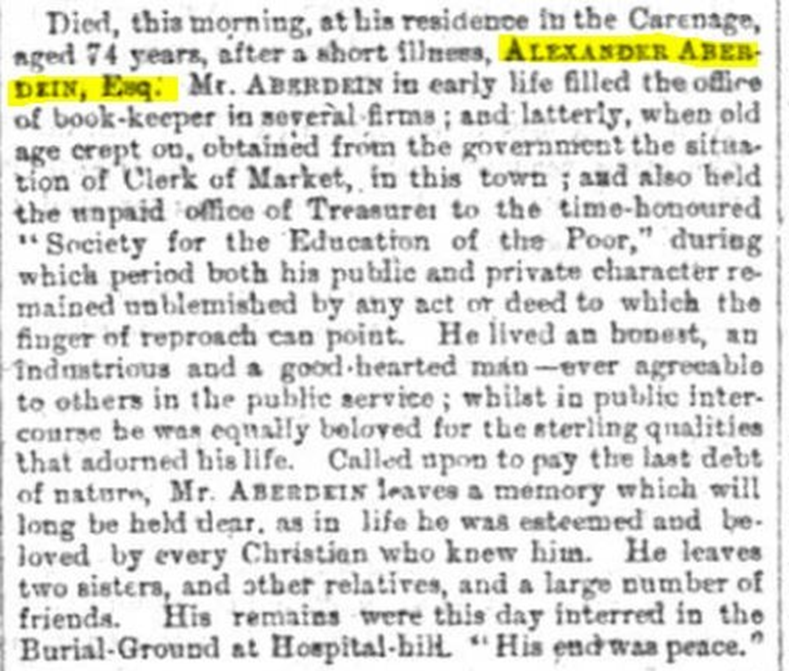
Alexander Aberdeen Junior’s life reflects a remarkable generational transition. His father’s decision to free Fanny and her children enabled Alexander to grow up as a free man, secure property rights, and participate in the civic and administrative life of Grenada in ways that would otherwise have been extremely difficult for a person of mixed heritage in the early 1800s. His long service, good reputation and prominent obituary show that he became a respected member of Grenadian society whose life bridged the eras of slavery, emancipation and early post-emancipation governance.


The Life of John Aberdeen

 John Aberdeen belonged to the second generation of the Aberdeen family established in Grenada by the Scottish planter Alexander Aberdeen and the formerly enslaved woman Fanny, whom Alexander freed in 1806. He was named in his father’s will of 1815.  

The earliest known reference to John Aberdeen appears in the Grenada Free Press of 2 February 1831. He is listed under the St Andrew’s Regiment of Militia as an absentee from muster. It should be noted that militia rolls were poorly attended across the Caribbean, and absences were frequent. Names appeared repeatedly in these lists without any consequence to a man’s social status, employment prospects, or respectability. 

This notice places John squarely within the class of free coloured or mixed-heritage men who, by the 1830s, were required, or socially expected, to serve in local defence forces. His presence on the roll indicates he was officially recognised as a free man and a resident of some standing in St Andrew, since militia rolls did not typically include the poor or transient.
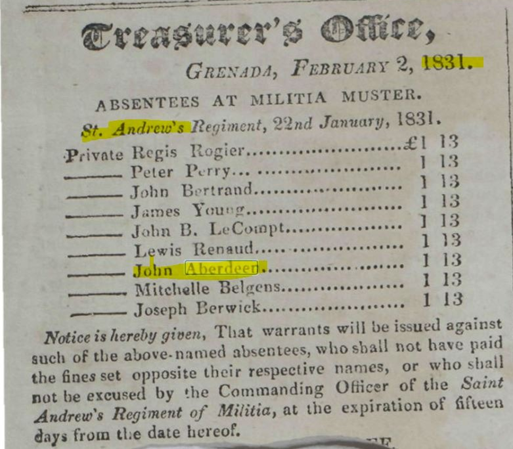
In the 1846 indenture relating to Fanny Aberdeen’s property, he appears as one of the executors of her estate, together with his brother Alexander Aberdeen.  Being named as an executor indicates that John was trusted, literate, and capable of handling legal responsibilities. It also shows that by the mid-nineteenth century he was considered an adult of maturity and authority, involved in managing family property and representing the interests of the Aberdeens in official matters. 

John’s appearance in both the militia roll and the indenture suggests that he was part of the core generation of the Aberdeen free coloured family, one that came of age in the decades between his manumission in 1806 and emancipation in 1838. Like others of mixed heritage in this period, he navigated a complex colonial society, gaining civic responsibilities even as racial hierarchies persisted. 

Although no known obituary survives for him, the pattern of his appearances suggests that he lived into the mid-nineteenth century and remained part of the network of free people of colour who increasingly shaped community life in Grenada.

 
The Life of Barbara Aberdeen (c.1797 – 22 November 1867)

Barbara was named as Alexander Aberdeen’s reputed daughter and described as a free mulatto girl. She would have been about 18 when he died. Her life can be pieced together only from brief appearances in Grenada’s surviving records, but even these fragments show a woman who held responsibility during a period of profound change on the island. 1817: 

Mother of Amelia Sim 

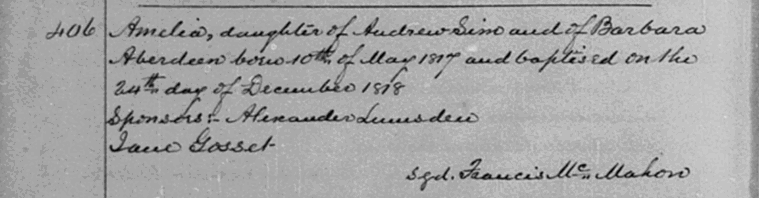
An 1818 baptismal record dated lists Amelia Sim, daughter of Andrew Sim and Barbara Aberdeen. She was born on 10 May 1817 and baptized on 24 December 1818 in St George’s. Ref  

Barbara is carrying her maiden name on the certificate. As Andrew is named in the register and Amelia carried his name, it is likely that Barbara and Andrew were in a recognised relationship but not legally married. 

Given her estimated birth year of c.1797, Barbara would have been around 20 years old when Amelia was born.   


1829: Acting as an Agent in St Patrick 

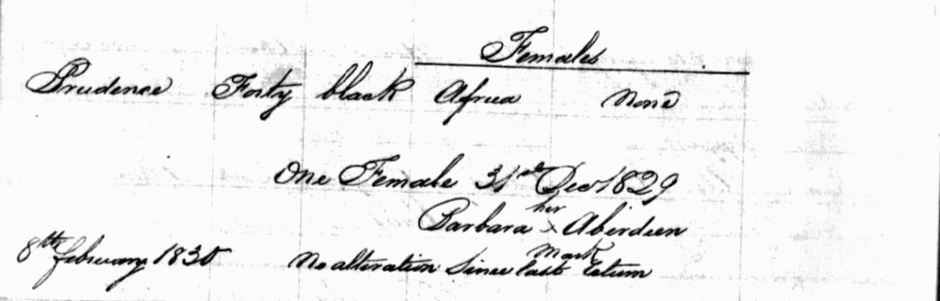
Barbara first appears in the 1828 and 1829 Slave Registers, where she is recorded as an agent for Andrew Sim in St Patrick. In that role, she submitted the registration of one enslaved person: Prudence, a 40-year-old African-born woman.  
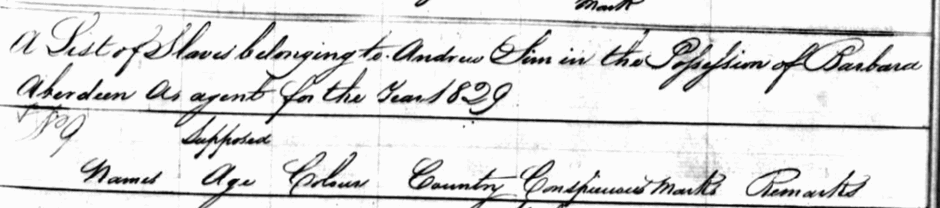

Her signature appears as an “X”, indicated she was illiterate.  

As Prudence was the only enslaved person under their ownership, and a woman, it is possible that Prudence was brought in by Andrew to support Barbara in her domestic duties, Amelia would be about 10 years old. 


Life Through Emancipation and Its Aftermath 

Barbara lived through the apprenticeship period and the transition from slavery to full freedom in 1838. Although there is no record of her owning property or enslaved workers directly, it is clear that Prudence was brought in to support her and Barbara’s role as an agent in 1829 shows that she was familiar with colonial administrative processes. 


Death in 1867 

Barbara Aberdeen died on 22 November 1867, aged 70 from “senility”.  However, In the mid-19th century, the word “senile” simply related to old age. It did not specifically refer to dementia the way we use it today. Many doctors used “senility” simply as a respectable way of saying the person’s body had worn out.
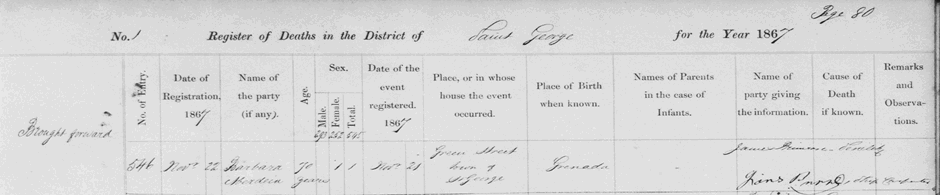
Her lifetime spanned the height of plantation society and the aftermath following emancipation. 

 -------------------------------------------------------------------------


The Enslaved by Fanny Aberdeen   

Table of Enslaved People held by Jane/Fanny Aberdeen by Year as recorded in the Slave Registers

  Key:
A = Acquired
B = Born
D = Died 
P = Present 
M = Manumitted
S = Sold 


SANDY (c.1777–after 1821)

Sandy was an African-born man who appeared on Fanny Aberdeen’s estate in 1817 at around 40 years old. Having survived the Middle Passage as a young adult, he worked for Fanny for at least four years until she sold him in 1821 to John Chapman. His sale suggests he remained physically capable despite decades of labour and trauma. Sandy’s life reflects the resilience of the African-born enslaved who endured removal, resettlement, and forced labour into late adulthood. 


NEILSON / NELSON (c.1782–1834) 

Nelson first appears in 1817 as a 35-year-old African man. He remained with Fanny through repeated deaths, sales, and restructurings, eventually becoming the last enslaved person she held. Nelson lived under Fanny’s ownership for at least 17 years, one of the longest-recorded relationships in the register. He died in 1834 of mal d’estomac. Despite his decades of survival his final years highlight the prolonged vulnerability of ageing African-born enslaved men. 


BILLY (1812–1822) 

Billy was born enslaved in Grenada and appeared in the 1817 register at age five. He grew up under Fanny’s control alongside Alicia, likely a sibling or close companion. In 1822, at just nine years old, he died of mal d’estomac. Billy’s short life reflects the precariousness of enslaved childhood in such places. 


NANCY (c.1783–1823)

 Nancy was an African-born woman aged 34 in 1817. She lived and laboured on Fanny’s estate for at least six years and died in 1823 at around 40 years old from mal d’estomac. Her death, like several others on Fanny’s estate, reflects a pattern of suffering among African-born women, who often bore the greatest emotional, physical, and reproductive burdens. 


LIDIA / LYDIA (c.1783–1826)

Lydia, an African-born woman, first appears at age 34. She remained with Fanny for nearly a decade. She likely participated in heavy labour and possibly mentoring younger Creole-born enslaved people. Lydia died in 1826 at age 41. Her long presence there underscores the reliance on African women in sustaining plantation workforces after the slave trade ended. 


CHARLOTTE (c.1784–1822) 

Charlotte was a 33-year-old African woman in 1817. She lived under Fanny’s ownership for at least five years and died in 1822 at about 37, also from mal d’estomac. Her record is one among several African women under Fanny’s control who died young from conditions linked to trauma and deprivation. 


ALICIA (1812–after 1829)

Alicia, born enslaved in Grenada in 1812, was recorded with Fanny from age five into her teenage years. She survived childhood deaths, repeated sales, and the dispersal of her companions. By 1829, she and Nelson were the only two enslaved people left with Fanny. After this she disappears from the record. 


LOUISA (c.1777–1819) 

Louisa was a 40-year-old African-born woman in 1817 and died two years later, aged 42, after suffering from “lame legs” and mal d’estomac’. 


 LEASE / LEECE (c.1795–1828)

Lease was a Creole woman born around 1795. She lived on Fanny’s estate from at least 1821 until she and her infant daughter Eliza were sold to Tomas Castale in 1828. She gave birth to a daughter, Eliza, in 1827, only to be sold the following year highlighting the fragility of enslaved family life. Her fate after sale is unknown. 


SUSANNAH (c.1808–manumitted 1828)

Born in Grenada around 1808, Susannah appeared as a teenager on Fanny’s estate and lived there throughout the turbulent 1820s. In 1828, at around 25 years old, she obtained her manumission from Fanny. She is one of the few enslaved people associated with Fanny whose freedom was formally secured before full emancipation. 


BRECHE / BREECHE (c.1790–after 1826)

Breeche was an African-born man, aged 32 in 1822. He remained with Fanny until 1826, when he was sold back to Julien Allan Delatouche. His sale suggests he retained economic value and physical ability despite the intense labour of his thirties. His trajectory reflects the common cycle of purchase, exploitation, and resale. 


JOHN PIERRE (c.1775–sold 1824)

John Pierre, a 47-year-old African-born man, was purchased by Fanny in 1822 and sold back to Delatouche two years later. 


BELLA (c.1781–sold 1823)

Bella was a 41-year-old African-born woman purchased in 1822. She was sold back to Delatouche in 1823, along with Julie. Her brief ownership shows the instability of enslaved women’s lives and the frequency of rapid turnover even in small holdings. 


BONNETTE / BONNET / RENETTE (1811–sold 1826)

Born in Grenada in 1811 and identified as a mulatto, Bonette was bought by Fanny in 1822. At age 15 she was sold back to Delatouche. Her early sale, before childbearing age, may indicate domestic training or perceived market value. Her life embodies the vulnerability of mixed-race children in the colonial slave economy. 


JEAN ROSE (1809–sold 1826)

Jean Rose was a Creole girl born around 1809. Acquired in 1822 at age 13, she remained with Fanny until 1826, when she too was sold back to Delatouche. 


JULIE (c.1798–sold 1823)

Julie was a young African-born woman, aged 24 when Fanny purchased her. She was sold back to Delatouche the following year. Her brief appearance suggests Fanny frequently traded enslaved women for profit or restructuring. 


JOHN (c.1803–after 1825)

John, aged 18 in 1823, was purchased and registered under “Jane.” In 1825 he was recorded as 20 years old on that same estate. His movements reflect a secondary property portfolio Fanny operated alongside her primary one. 


ROSETTE (c.1797–after 1825)

Rosette, purchased in 1823 at about 26 years old, was recorded as a mother by 1825, having given birth to Margaret. Her life reflects the forced reproductive role imposed on enslaved women, whose children enlarged the labour force. 


FRANCES (born 1821/1824) 

There were two girls named Frances: Frances (born c.1821) Purchased in 1823 as a two-year-old, she lived on the estate attached to Jane Aberdeen’s secondary property. She appears again in 1825, aged four. Frances (born 1824)Born on Fanny’s main location, this infant’s birth was recorded in the 1825 register. She grew up in an environment of sales, deaths, and shrinking household numbers; nothing further is recorded about her after early childhood. 


MARGARET (born 1824)

Born to Rosette on Jane’s secondary location, Margaret symbolises the continuation of enslaved family lines despite the absence of stability or protection from sale. She was recorded at age one in 1825. 


ELIZA (born 1827)

Eliza was born to Lease in 1827. She was sold with her mother to Tomas Castale in 1828 when she was only one year old. Her forced removal as an infant was typical of the era and demonstrates how enslaved families were routinely fractured. 


DESIREE (c.1824–manumitted 1827)

Desiree, aged three in 1827, was manumitted that same year. She is the youngest person in Fanny’s records to obtain freedom, likely reflecting a specific request or negotiated arrangement. 


FANNY (c.1807–sold 1832)

Purchased in 1830 and described as a 23-year-old mulatto woman, she arrived with her three young sons. They formed a rare intact family group on Fanny’s estate. In 1832, the entire family was sold to Catherine Drysdale. 


CHARLES (born c.1823–sold 1832)

A seven-year-old mulatto child purchased as part of the above family unit. He was sold with his mother and brothers in 1832. 


DAVID JAMES (born 1828–sold 1832)

Brought under Fanny’s control as a 19-month-old baby in 1830. He was sold at around 3¾ years old to Catherine Drysdale in 1832. 


GEORGE (born 1829–sold 1832)

A 3½-month-old infant in 1830, George was sold at 2¼ years old with the rest of his family in 1832. His presence shows his mother had recently given birth before being taken by Fanny. 


FELISHA (c.1815–1831)

 Felisha was a 16-year-old girl who died in 1831 of mal d’estomac. Her youth, gender, and the manner of her death underline the emotional and physiological toll that enslavement inflicted on adolescents. 


SUMMARY 

Across the years 1817 to 1834, more than thirty enslaved people lived, laboured, were born, died, bought, or sold on the small St Andrew estate managed by Jane “Fanny” Aberdeen. Their lives reflect the broader instability of Grenadian slavery in its final decades, as well as the human endurance required to survive it. 


The 1817 register shows a workforce dominated by African-born men and women, Sandy, Nelson, Nancy, Lydia, Charlotte and Louisa, who had survived the Middle Passage years earlier and were forced into hard labour as middle-aged adults. They formed the backbone of the work force, working alongside one another until death or sale removed them from the records. Several died from mal d’estomac, a term associated with extreme trauma, starvation, illness and the psychological suffering of enslavement. 


The creole born children grew up in constant insecurity. Billy and Alicia, both born in Grenada and registered at age five, symbolise the vulnerability of enslaved childhood. Billy died by age nine from mal d’estomac, while Alicia survived into adulthood but ultimately disappeared from the records. Other children, like Frances (1824), Margaret (1824), Desiree (1827), and Eliza (1827), were born into slavery only to be sold, manumitted, or removed within a few years. 


Families existed but were often broken apart. Lease and her daughter Eliza were sold together in 1828.  Rosette and her daughter Margaret, were kept together. Fanny and her three sons (Charles, David James, and George) were purchased as a unit and sold together two years later.  But other family ties were severed repeatedly. Infants and toddlers were frequently sold or died young, and family groups were transferred between places, bought back by former owners, or separated permanently. 


Fanny Aberdeen regularly bought enslaved people in batches, particularly in 1822 and 1830, and just as often sold them back into the market. Adults such as Bella, Julie, John Pierre, Breeche, Bonette, and Jean Rose were acquired and then eliminated through sale only a few years later. Every enslaved person lived with the knowledge that they could be removed at any moment. 


A small number achieved manumission. Two individuals; Susannah (1828) and Desiree (1827) were freed by Fanny. They were rare exceptions in a system otherwise defined by perpetual bondage. 


Death from distress and deprivation was common. Multiple individuals; Louisa, Billy, Charlotte, Nancy, Felisha, and finally Nelson died of mal d’estomac. Many died in their 30s and 40s, consistent with the life-shortening effects of plantation labour, high stress, hunger, abuse, and chronic trauma. 


By the early 1830s, only Nelson and Alicia remained from the original group. After Alicia disappeared from the records, Nelson stood there alone. He died in 1834 and was the last enslaved person held by Fanny Aberdeen.


 ------------------------------------------------------------------------- 

Mal d’estomac

 In the 1800s, when an enslaved person in Grenada was recorded as dying from mal d’estomac (“stomach disorder”), it often referred to a condition linked to dirt-eating, known medically as pica, but described by plantation doctors as Cachexia Africana. 

Many enslaved Africans continued the longstanding cultural practice of consuming certain types of clay, something widely done across Africa, the Americas, and Indigenous societies for medicinal, dietary, or spiritual reasons. But in the Caribbean plantation environment, their attempts to recreate this practice were misunderstood and forbidden.

 Enslaved people ate earth for reasons including hunger, stress, malnutrition, cultural continuity, mineral supplementation, and psychological survival. But planters and doctors saw the behaviour as a “disease,” blaming the supposed weakness of African bodies rather than the brutal conditions of slavery. Instead of recognising the role of starvation, trauma, and deprivation, they labelled the habit mal d’estomac or simply “dirt-eating,” claiming it was fatal and widespread. 


European women who suffered from pica for similar reasons, pregnancy, anaemia, stress were treated gently and seen as curable. Enslaved Africans, however, were seen as mentally flawed or physically inferior, and the same behaviour was considered deadly. Plantation doctors frequently wrote that many enslaved people who developed the habit were “lost,” and some claimed that half of plantation deaths were caused by this so-called disorder.

 In reality, the deaths often stemmed from malnutrition, poor sanitation, untreated infections, parasites, dehydration, and the extreme physical and psychological pressures of enslavement. The label mal d’estomacprovided planters with a convenient explanation that hid the true causes of illness and mortality on estates. 


Thus, death by mal d’estomac in Grenada was largely a product of cultural misunderstanding, medical racism, and the harsh realities of plantation life. It reflected the gulf between African knowledge systems and European plantation medicine, and it exposed the ways enslavers used pseudoscience to blame enslaved Africans for the suffering that slavery itself inflicted.

------------------------------------------------------------------------- 
 The Enslaved by Barbara Aberdeen 


Prudence was born in Africa and was forced into the transatlantic slave trade. She survived the Middle Passage and first appears in Grenada’s records in 1817, legally owned by Andrew Sim but in the possession of George Watson. 

Since she was born in Africa, there is no record of her actual date of birth but she is estimated to have been born in 1789 so would have been about 28 in 1817.    
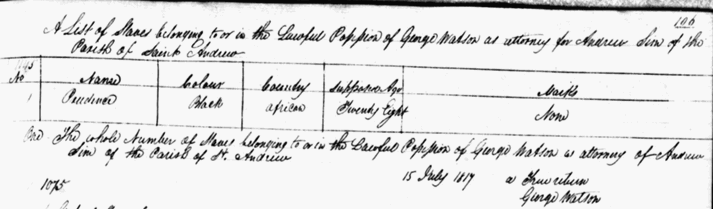

By 1828 she was in the possession of Barbara Aberdeen, likely working in her home where she would have performed domestic work such as cooking, washing, cleaning and tending a garden.  Prudence may also have helped to raise Barbara’s daughter, Amelia and have been the steady, grounding adult in the household who quietly kept everything running. 

She is seen again in the 1829, 1833 and finally 1834 slave registers under Barbara Aberdeen.    
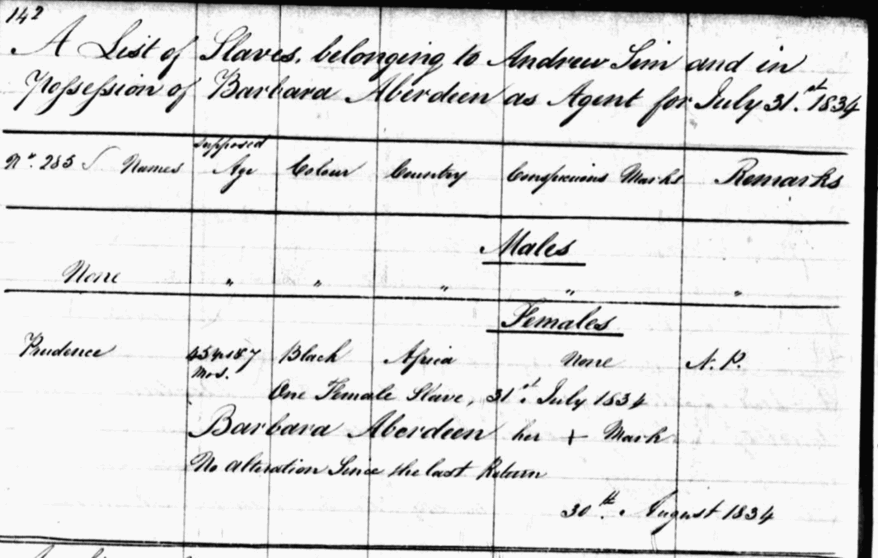
She worked for Andrew Sim for at least 17 years. Her character emerges here as a dependable, capable and trustworthy person. 

Now aged about 45 years old, she lived long enough to see slavery end and to enter the apprenticeship system that followed. 

Though the archive records little more than her name, age, and origin, the continuity of Prudence’s life suggests a woman of quiet strength, resilience, and dignity.  She was someone who endured profound upheaval yet remained a steady presence through decades of change in Grenada. 

Acknowledgements

 We are grateful to Dr. John Angus Martin of the Grenada Genealogical and Historical Society Facebook group for his editorial support and Owen Hankey for content contributions. 


Example Text

The Aerstins were small-scale but active enslavers, transferring, selling, and inheriting people between 1817 and 1834. The individuals they held endured repeated displacements yet demonstrated resilience, with some living to see emancipation and shaping Grenada’s future communities.

Fact File: Elizabeth Aerstin 

Claim Number: 147 

Compensation Award:  £27 10S 5D 

Number of Enslaved in Claim: 1 

Parish: St. George Parliamentary Papers: p. 95

 ------------------------------------------------------------------------- 

The Aerstin family, as recorded in the early 19th-century Slave Registers of Grenada, appears to be part of a small, interconnected group who were involved in the enslavement of people. The family is likely connected through blood relations, with John, Elizabeth, Sarah William and Catherine Aerstin all listed as proprietors in the Slave Registers. Their holdings were relatively modest compared to larger plantations. 

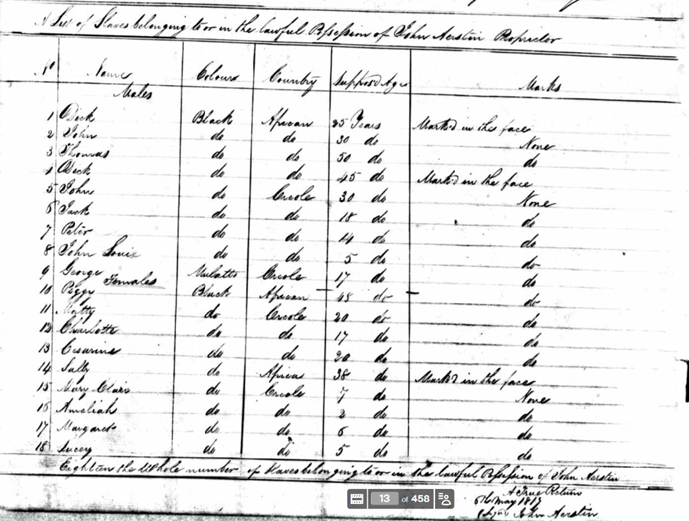
John Aerstin emerges as the central figure in the family’s history in early-19th-century Grenada. In 1817 he was based in St George that held eighteen enslaved people.

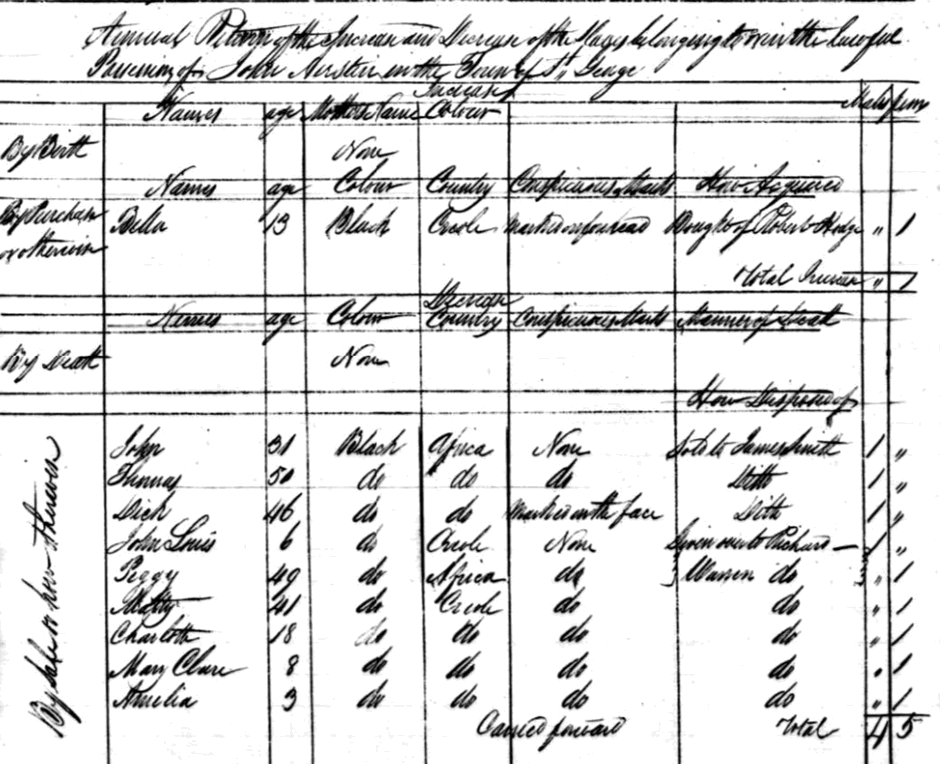
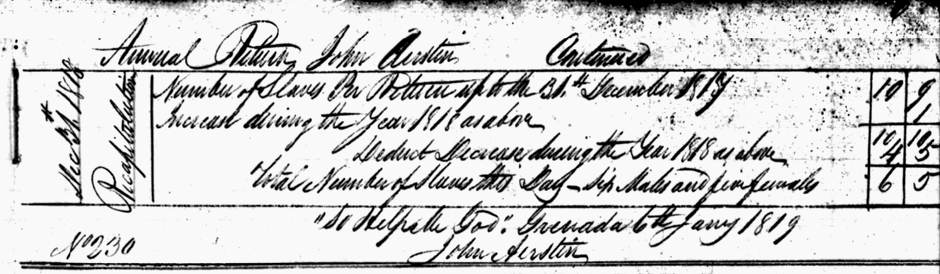
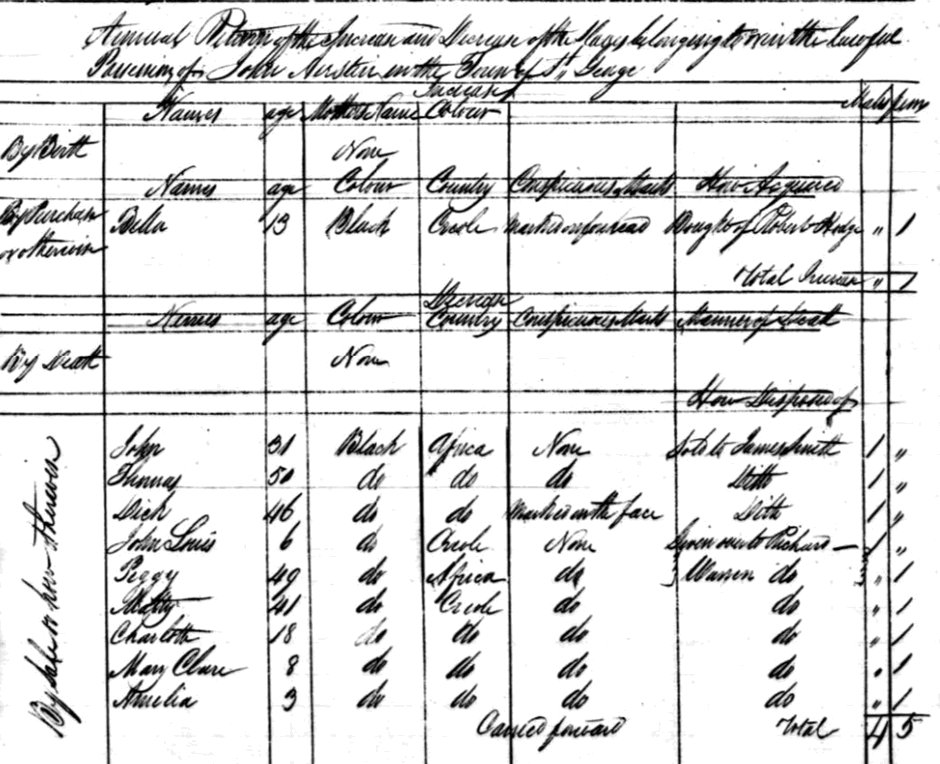
The 1818 register showed a number of changes. John bought 13 year old Grenadian Bella from Robert Hodge. He sold John, Thomas and Dick to James Smith. John Louis, Peggy, Matty, Charlotte, Mary Clare and Amelia were also sold, this time to Richard James Warren.


He ended the year with 11 enslaved people under his control.

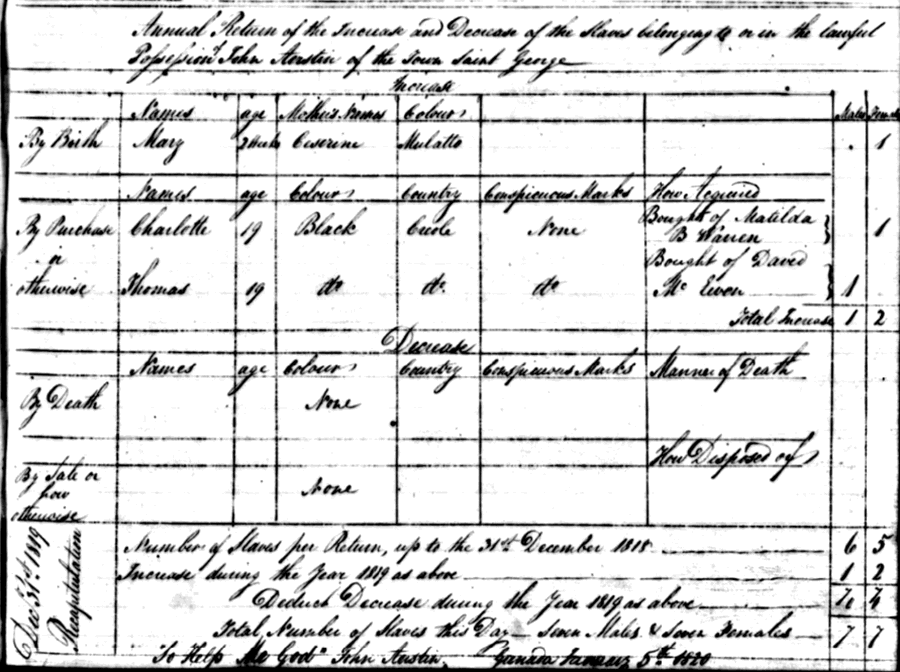
In 1819, the Slave Register shows that a child named May was also born under his control. Her mother, Cesarine, was described as a Black Creole, born in Grenada, while May was listed as a mulatto child, her mixed parentage left unspoken but implicitly revealing the dynamics of power on the plantation. 

John enslaved two more people that year; Charlotte from Matilda B. Warren (perhaps the same Charlotte that was sold the year before) and Thomas from David McEwen. They were both 19 years old. 
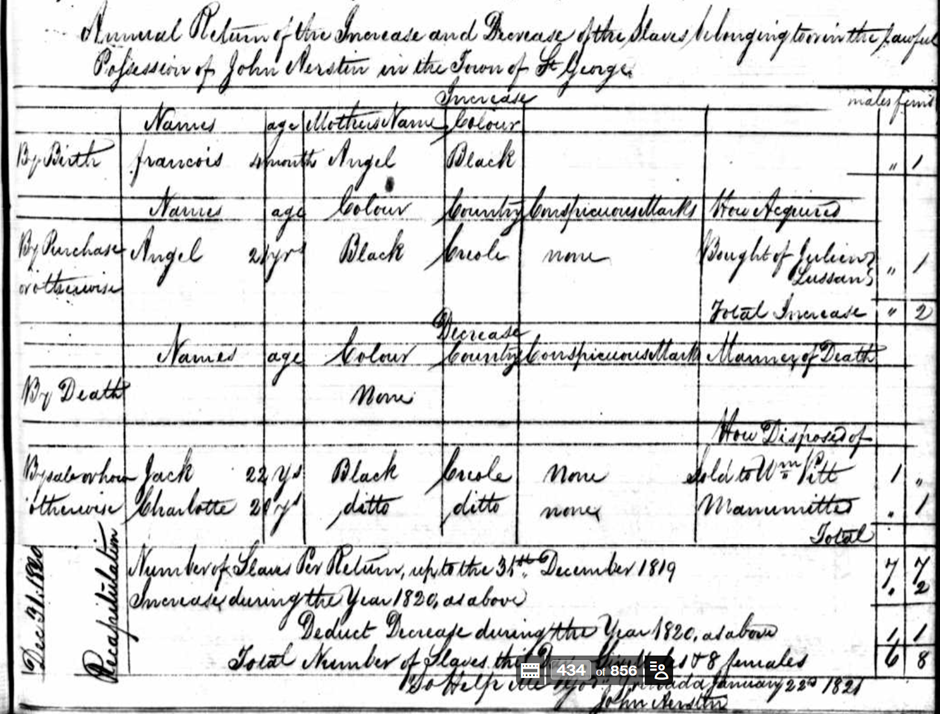
 In the 1820 Slave Register, John had 14 enslaved people under his control (6 male, 8 female).  He made the following changes. He sold Jack (22) to William Pitt and manumitted Charlotte (20).  He bought Angel (21) who gave birth to a daughter Francoise.


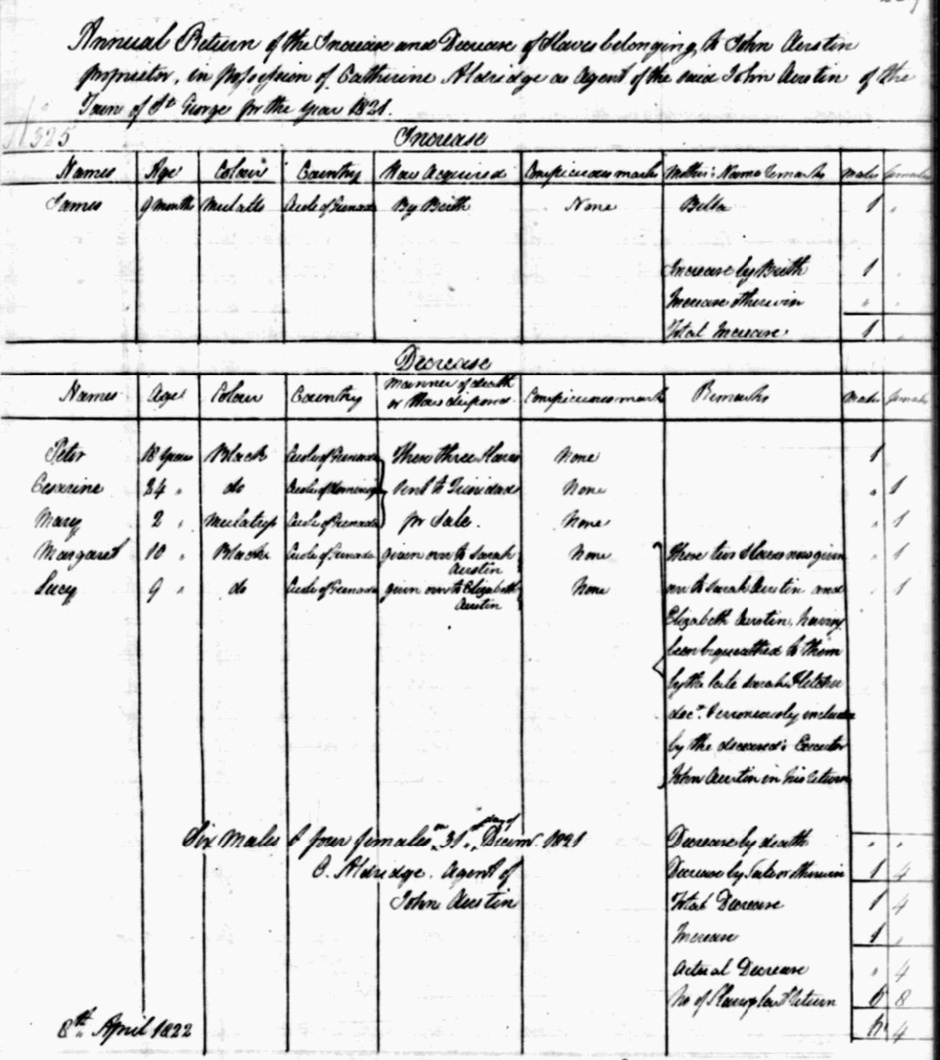
The 1821 Slave Register shows that he had placed his interests under the possession of Catherine Aldridge.  

Peter, Cesarine, and May were shipped to Trinidad for sale, while Margaret and Lucy were transferred to Sarah and Elizabeth Aerstin respectively under a contractual arrangement tied to the late Sarah Fletcher, John was the executor of her will. It is likely that he was closely related to Sarah and Elizabeth in some way. There is a record of John AERSTIN selling an enslaved worker under execution in the Marshall’s office on 18 Feb 1822.  
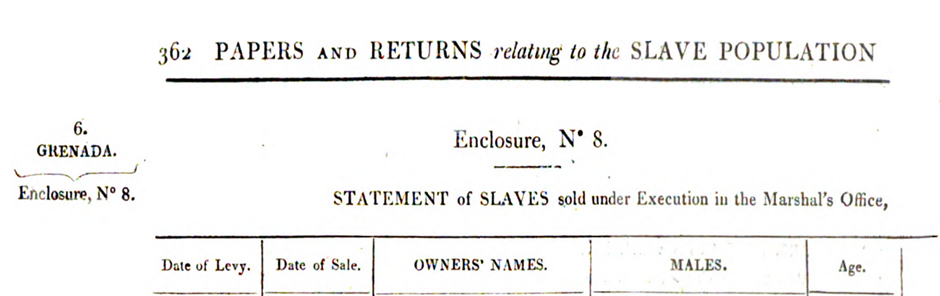
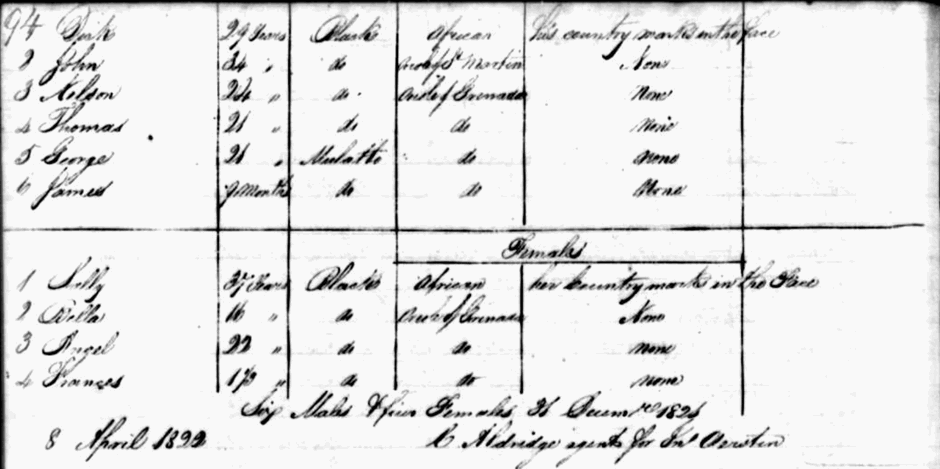
The Slave Register of this year, again under the possession of Catherine Aldridge showed 6 males and 4 females under his control. James was 9 months old.

He likely died before emancipation, which would explain why no compensation claim exists under his name. There is also a record of a John Aerstin who died in Grenada in 1831, aged 29. 
John may have had children with a woman recorded variously as Elizabeth Bagenhall, Backenhall, or Ballingale. The records of Samuel (1808) Ann (1807), Jane (1810), and Charles Aerstin (1814) suggest that a parallel domestic life existed alongside his role as plantation owner. There is also a record for the birth of Thomas Aerstin with Louisa Harris in 1820,  Elizabeth Helen Aerstin with Catherine Pire in 1829.


Elizabeth Aerstin

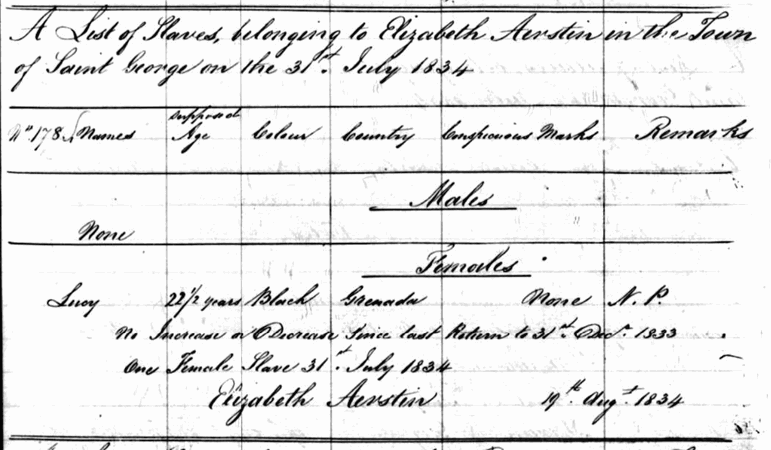
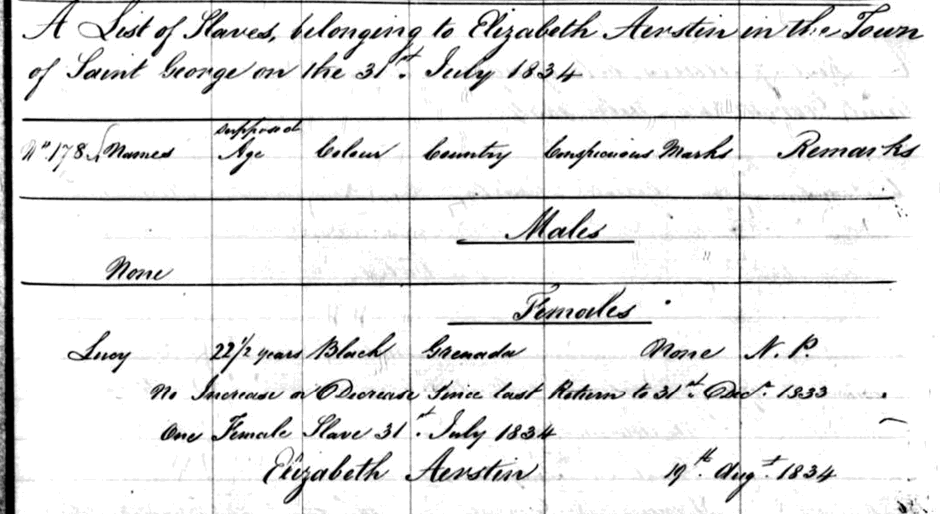
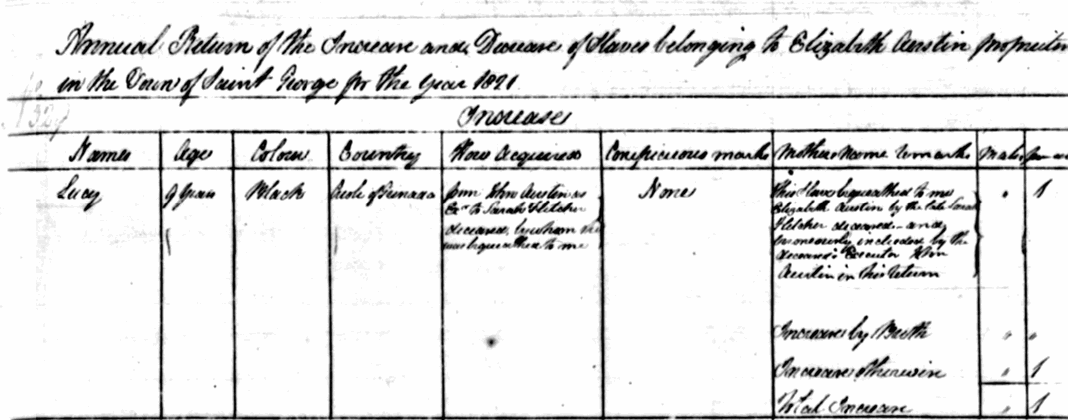
 Elizabeth comes into focus through the 1821 Slave Register, when she appears as the owner of Lucy, who had been bequeathed to her by the late Sarah Fletcher. The record reads “This Slave bequeathed to me Sarah Aerstin by the late Sarah Fletcher deceased & commonly included by the deceased’s Executor John Aerstin in his return”  


This transfer was formalised through the executor, John Aerstin. For more than a decade, Elizabeth’s register entries show no change: she owned only Lucy, and her holdings neither grew nor diversified. Elizabeth’s life appears modest compared with John’s. She had enslaved one person and did not engage in buying or selling others. Lucy appeared in the registers of 1824, 1825, 1829, 1833 and 1834. 

When emancipation came in 1834, her enslaved worker, Lucy, by then 22½ years old, was legally freed. Elizabeth later received compensation in October 1835, amounting to £27 10s 5d, for the loss of Lucy’s labour.   

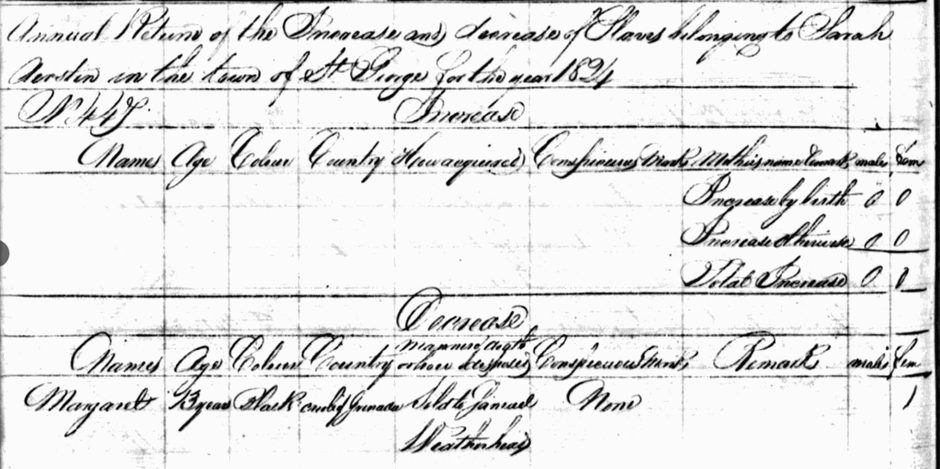
Sarah AERSTIN was also included in the 1821 register. She is listed as the owner of Margaret, a ten-year-old bequeathed to her by the late Sarah Fletcher under the same executor, John Aerstin, like Elizabeth. Sarah’s small-scale ownership resembles Elizabeth’s.  
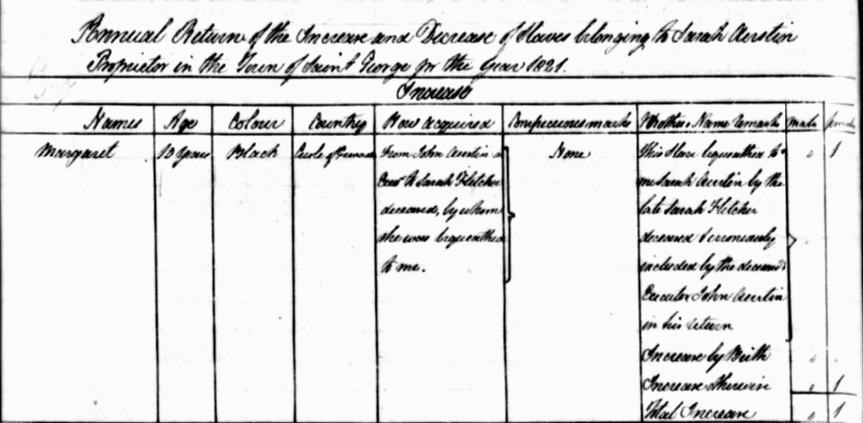

By 1824 she had sold Margaret, then aged thirteen, to Samuel Weatherhead. She held one other female enslaved person at that time, though no further details are recorded. After 1824, Sarah disappears from the registers entirely. Whether she died, migrated, married under a different surname, or simply ceased to own enslaved people remains unknown.


William Aerstin 

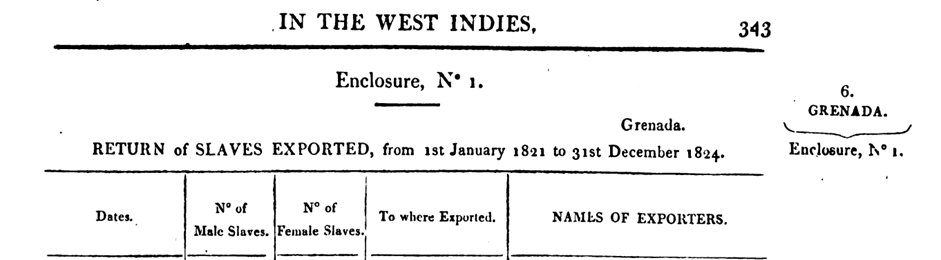
William Aerstin appears briefly but significantly. On 7 April 1821 he exported three enslaved people; two females and one male, from Grenada to Trinidad. These individuals may have been the same Peter, Cesarine, and her daughter May who had been enslaved by John Aerstin and were removed around the same period. His actions suggest that William participated directly in the inter-Caribbean slave trade.

There is a record of a William and Rose Aerstin having a son, Edmund,  born on 9 November 1823 in St George.   

Catherine Aerstin
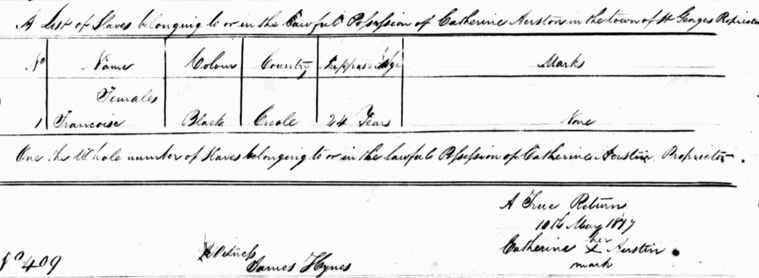
Catherine enters the historical record in 1817 as the enslaver of a woman named Francoise in St George. Her involvement appears minimal, and it is unclear how she connects to John or the others. She may have been a relative, wife, or widow, or simply part of a wider Aerstin network in the parish.

Summary 

Collectively, the Aerstins formed a small but active slave-owning family in St George, participating in the transfer, management, and sale of enslaved people between at least 1817 and 1834. Their activities spanned  ownership (John), small-scale inheritance and custodianship (Elizabeth and Sarah), and intercolonial exporting (William). The Aerstin family’s slaveholding activities were relatively small in scale but typical of the era, involving the inheritance and sale of enslaved people within family structures. The connection between John, Elizabeth, and Sarah suggests a tight-knit family unit. The lack of further records for Sarah and the relatively limited number of enslaved people held by  Elizabeth contrasts with the slightly larger operations overseen by John before his death. The family appears to have profited from the British system of compensation after abolition, which rewarded slaveholders for the loss of "property" when enslaved individuals were freed.

The Enslaved

The people enslaved by the Aerstins reflect the human stories behind the numbers, registers, and transactions. They include children, mothers, young adults purchased for labour, and individuals forcibly exported across the Caribbean. 

John, Thomas and Dick 

Born in Africa, John, Thomas and Dick had all crossed the Atlantic in chains and survived the horrors of the Middle Passage. All carried with them memories of another continent, a childhood spent beneath a different sun, before being forced into a world that stripped them of their name and history. All three were bound by a shared experience of loss and endurance. 

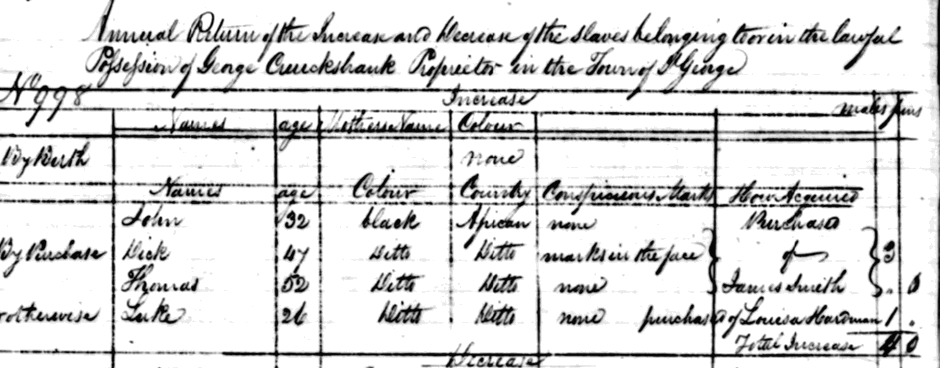
In 1817, their names appeared together in the records of the John Aerstin  their lives catalogued as property. Then, in 1818, their fates intertwined yet again as they were sold together to James Smith. The sale meant the wrenching separation from what little community they had built, but it also meant that, at least for now, they would not face the unknown alone. 

You can imagine, on the journey to their new destination, they would reminisce of the stories from their homeland, whispering fragments of songs and traditions that had survived the years. Thomas, despite his fifty years remained a figure of quiet strength, his endurance a silent testament to resistance. John, the youngest at 30, drew strength from their presence, learning that survival was not just about the body, but about memory and companionship. 

They faced an uncertain future. Yet, by holding onto each other, they carried with them the spirit of endurance and the hope that, no matter how the world sought to break them, their lives and their memories of Africa would persist. 

But their reprieve was brief. James Smith, into whose hands they had been delivered, did not intend to keep them for long. Almost immediately, he arranged their sale to George Cruikshank, another figure in the tangled web of Caribbean slavery. For John, Dick, and Thomas, it was another abrupt transition, their fates dictated by the shifting interests of men whose lives were built on the trafficking of others. 

This was the last we saw of Thomas.
James Smith appears from the record to be more of a middleman than a long-term owner. His rapid transfer of the men suggests he was a trader, one who moved enslaved people as commodities, seeking profit in every transaction rather than seeking to cultivate or manage estates. For John, Dick, and Thomas, this meant their lives were measured in values and exchanges rather than roots or relationships, and each new sale threatened further separation and uncertainty. Still, moving as a group, they clung to the fragments of familiarity and memory that could not be sold, even as the world around them changed with every transaction.

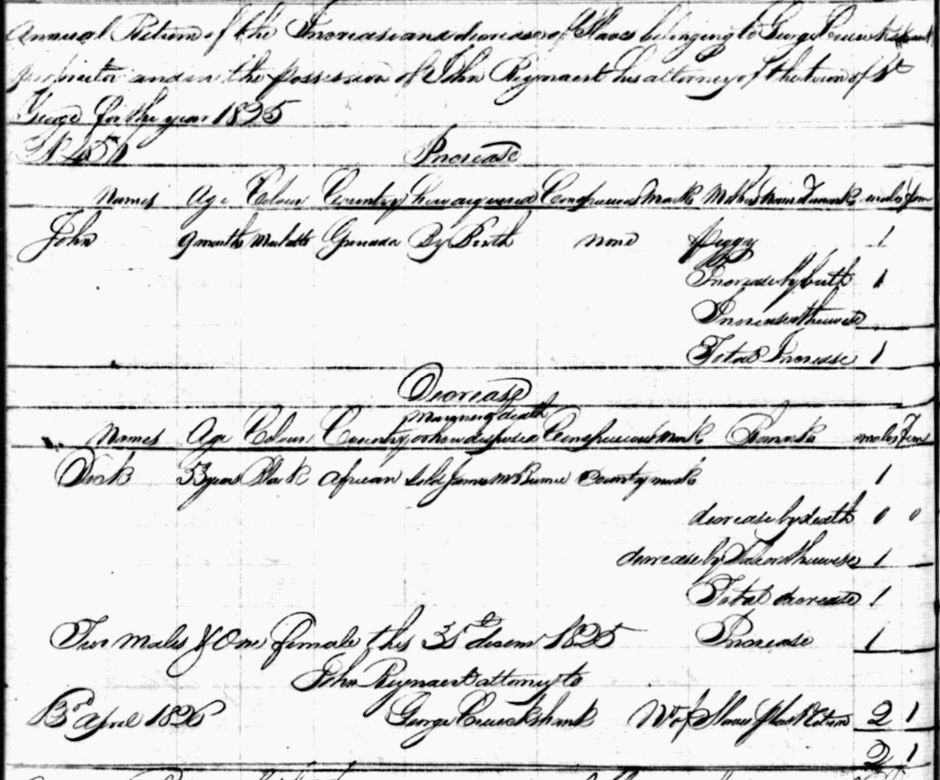
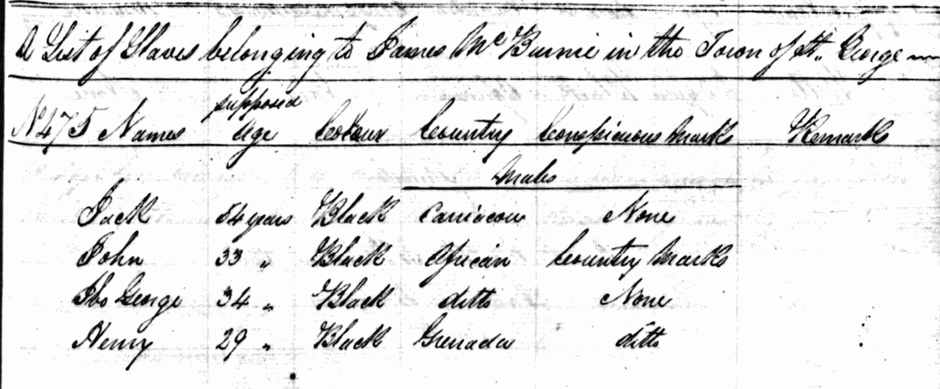
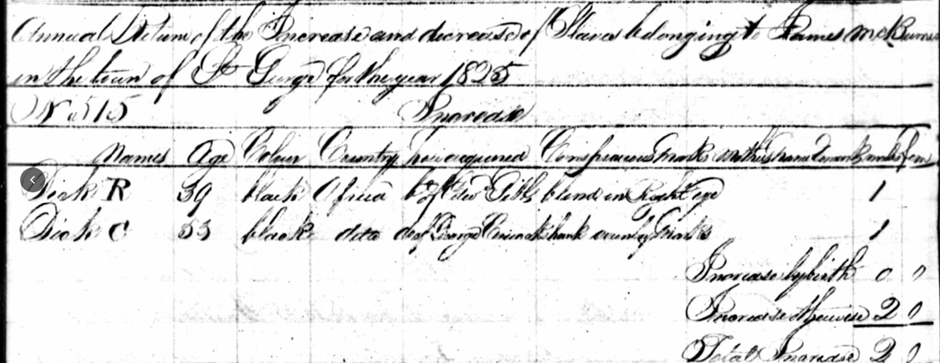
Dick was sold again on 1825 to James McBurnie. The record now whos him to have country marks most likely on his face.  This transaction marked yet another upheaval in Dick’s life, as he was forced to leave behind any sense of stability he might have begun to rebuild. Each sale chipped away at the fragile connections to people and place, but Dick’s repeated presence in the records is a testament to his endurance. Despite the unrelenting cycle of displacement and uncertainty, he continued to survive his story a silent chronicle of resilience amid continual upheaval.

George Cruikshank went on to claim compensation for 3 enslaved people.  There was a black African called John who was one of them but born c.1791. As birth dates of enslaved Africans were not recorded by traders, their age was assumed and manipulated for commercial gain.  Could this in fact be the John we are following.  If so, he managed to survive through this entire ordeal! 

Dick appears in James McBurnie’s 1825 register, age 59. Now known as Dick C as there was another Dick in the register. There was an African  John listed too but the dates don’t match the one we are following and the country marks would be a change from the earlier records – but we saw this change with Dick.  This was the last we saw of Dick.


Jack, Dick and Peggy 

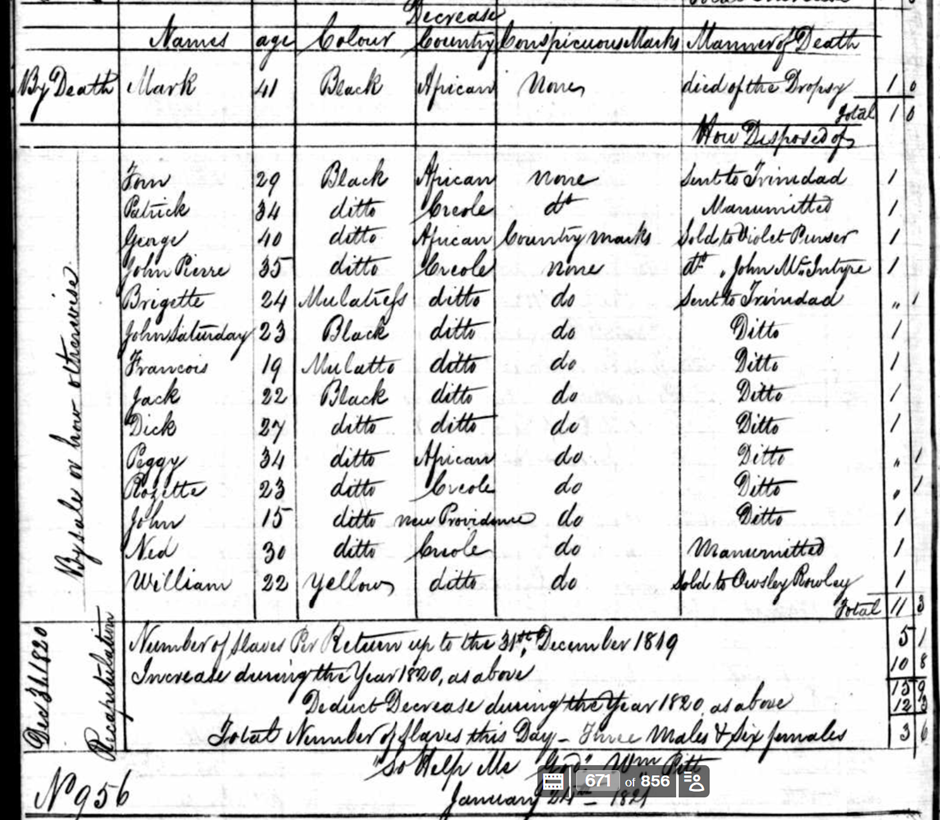
Jack (21), Dick (28) and Peggy (51) were sold to William Pitt in 1820. They faced another sudden displacement. This was further impacted by their onward sale as William sent them to Trinidad with a few others. 

Their fortitude lies in the courage with which they confronted the unknown: torn from familiar surroundings, yet carrying with them unspoken resilience that they needed to survive.

Peter 

Peter was born enslaved in Grenada and was transported to Trinidad just as he entered adulthood in 1821. His fortitude is found in his journey: the heartbreak of removal, the strength to adapt again, and the courage to continue living in a world that repeatedly uprooted him. 

John Louis, Peggy, Matty, Charlotte, Mary Clare and Amelia 

We can see from John Aerstin’s register that these were all sold to Richard James Warren in 1818.

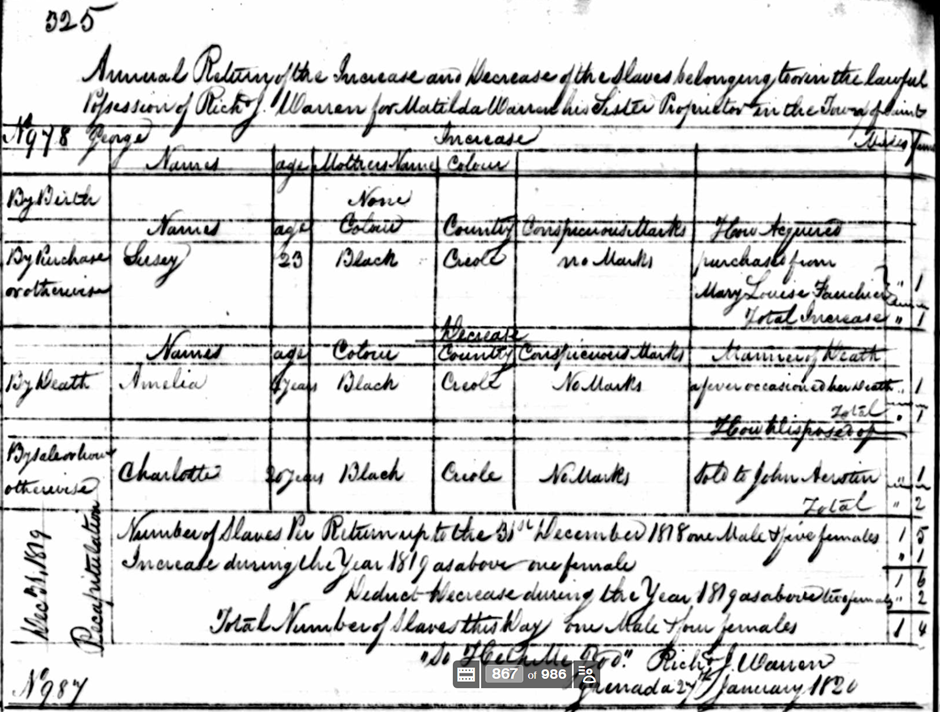
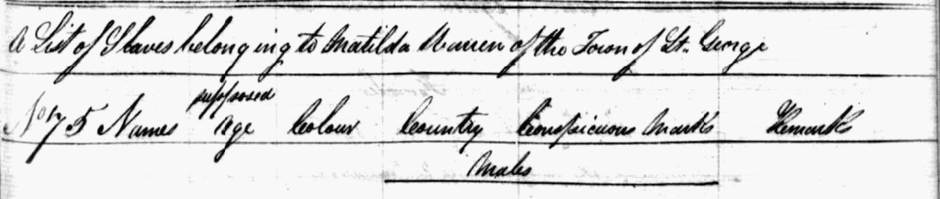
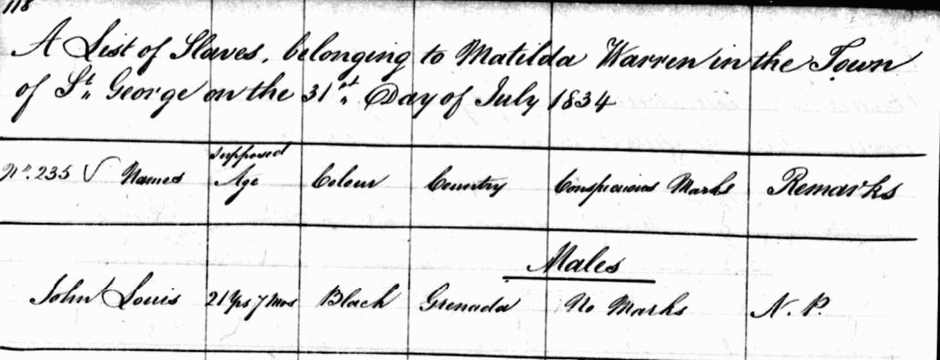
Richard Warren’s slave register for 1819 tells us more.  Richard was the legal owner but they were for his sister Matilda Warren who was a business owner in St George.  He recorded Amelia’s death that year, age 47 from a fever. He also sold Charlotte (20) to John Aerstin.

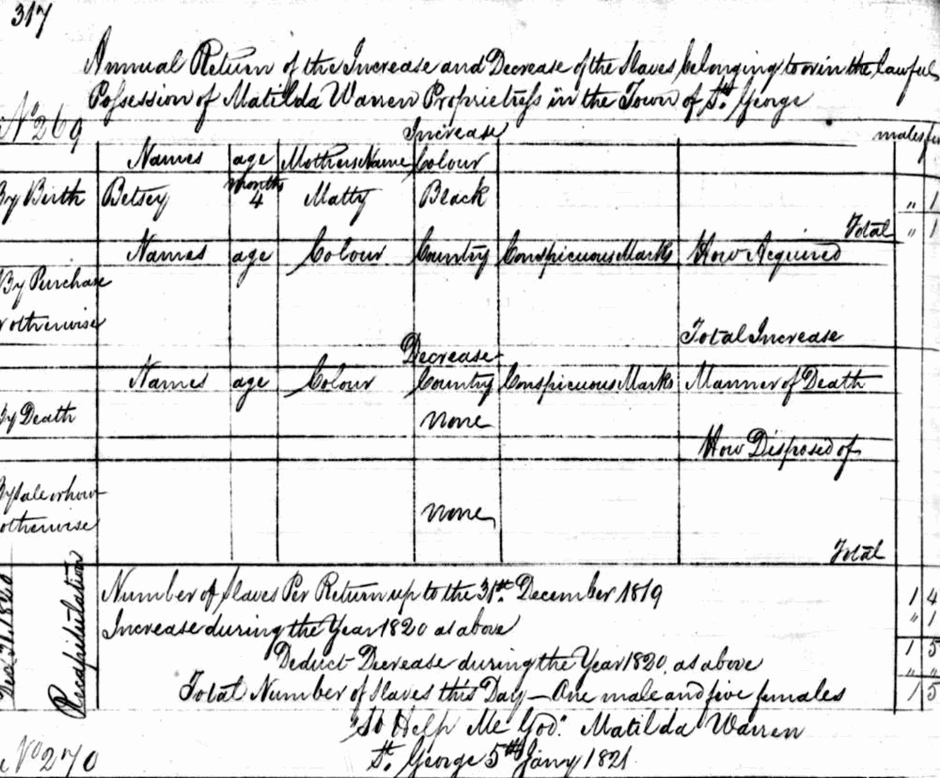
The following year, we see that Matty gave birth to a daughter Betsey and that the holding was in the lawful possession of Matilda and not Richard. In fact, it might be safe to assume that he had died as his name disappears from all future records.

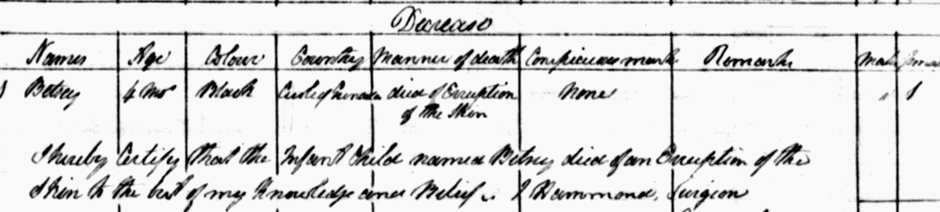
Unfortunately, Betsey died in infancy aged 4 months. The record says that she died from eruption of the skin which was a term used to describe a range of issues including ulceration, yaws (a common chronic infectious disease) or even smallpox. As enslaved people had limited access to medical treatment, a mild skin eruption could become life-threatening through infection, fever or septicaemia.

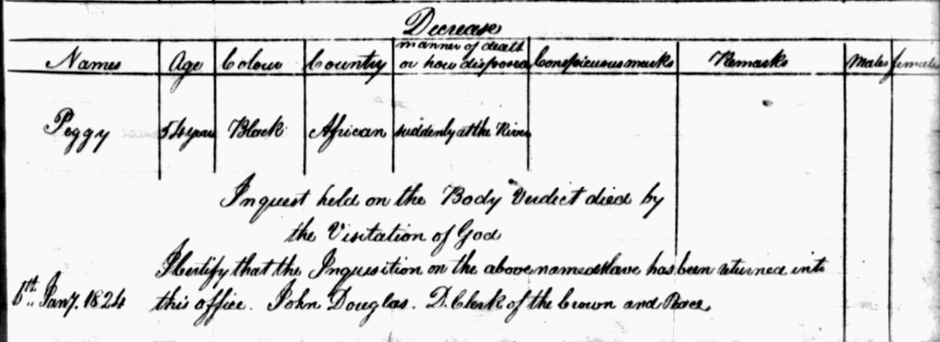
Sadly, Peggy died in 1823. An inquest concluded that she had died by the virtuation of God which really meant she passed by natural causes, at 54 years old.  The inquest may have been called for because of the suddenness of her passing. The Amelioration Act that was passed in 1823 required such an inquest if a death had been sudden, suspicious or resulting from severe punishment. The act was passed as the British government were facing huge pressures from abolitionists and wanted the system to appear more humane and reassure Parliament that the system was being reformed. A coroner would be appointed and a white jury. Even if the death had been as a result of brutal treatment, the enslaved witnesses were not allowed to testify and prosecutions of the perpetrators were almost non-existent.

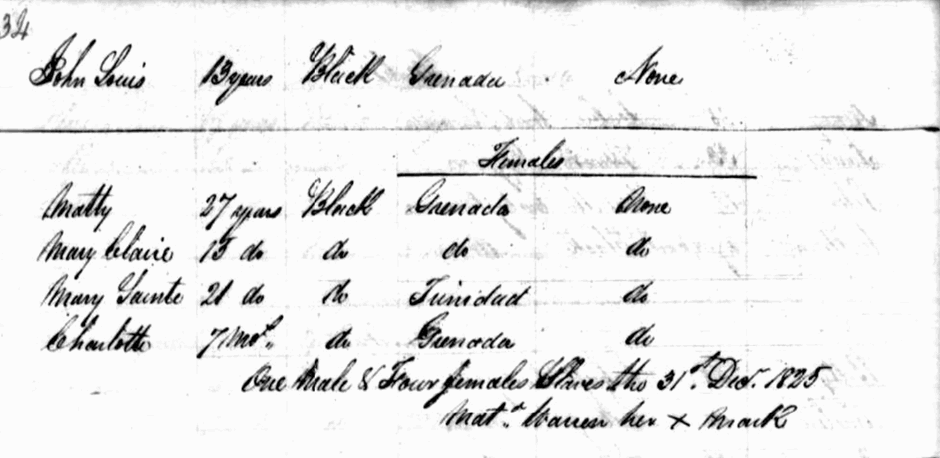
We see John Louis (13), Mary Claire(15) and Matty (27) and in Matilda’s register of 1825.

There was mixed news in 1829. 

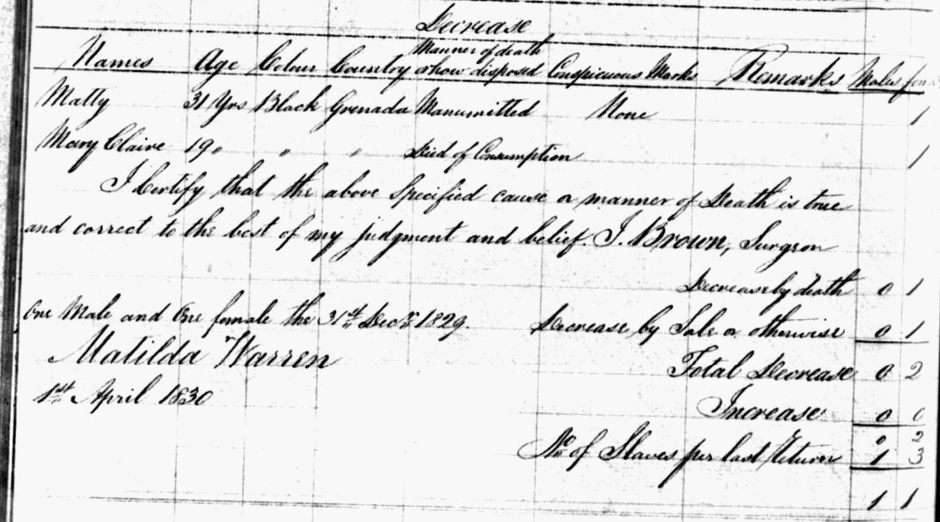
Matty was manumitted in that year and was free from bondage that had been part of her whole life to that point. At 31, she could finally start planning the rest of her life. 

Mary Claire died of consumption. This was a common condition in enslaved people due to the unsanitary and confined conditions they had to live in. She was just 19.

Matilda went on to claim compensation for the 5 people she had enslaved in 1834. One of which was John Louis. He survived!  He was also just 21 years old so, after the period of apprenticeship, he would have been free to live a life more of his choosing.

Cesarine and May 

Cesarine was a black woman born in Grenada. She gave birth to May in 1819 from a white father (likely to have been an overseer). She was  transported to Trinidad, thankfully with May, for onward sale in 1821. Despite all this, she remained a mother, a survivor, and an important constant for her daughter. 

Margaret 

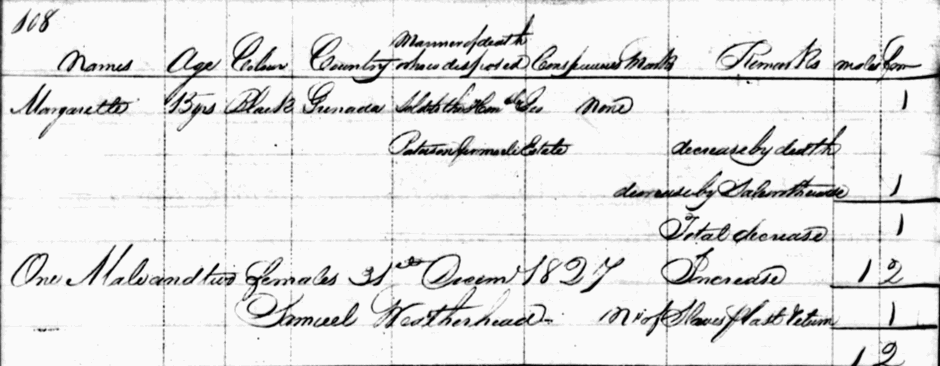
Margaret saw many changes in her early life. She first appears in the register of 1817 under the control of John Aerstin. She was then transferred to Sarah Aerstin in 1821 who sold her to Samuel Weatherhead in 1825.

She was on the move again in 1827 as Samuel sold her on. She was still just 15 years old.

Margaret’s childhood consisted of constant reassignments between households. Each shift required adaptive strength. Her ability to withstand separation, reattachment and new environments is itself remarkable. 

Lucy 

Lucy possesses one of the longest and clearest life histories in the Aerstin records. She was transferred to Elizabeth Aerstin in 1821 and remained with her through 1834. Her survival from infancy to adulthood during the harshest years of slavery demonstrates deep resilience. In 1834 she finally saw the end of enslavement at 22, living proof that fortitude endures even when freedom is delayed.

Angel and Francoise 

Angel was taken under John Aerstin’s control in 1820 and gave birth to a daughter, Francoise soon afterwards. She was 21.  Angel would have to negotiate a life of demands, long hours on top of motherhood. Yet she continued, nurturing her daughter despite uncertainty about their future. Francoise represents the fragile but determined emergence of new life in an environment built on oppression. 

John 

This Martinique-born man, present in 1829, had already endured migration between islands. His appearance suggests a life shaped by multiple colonial systems. His fortitude lies in surviving across borders, labour regimes, and decades of upheaval.

Summary 

The stories of the enslaved associated with the Aerstin family reveal lives marked by relentless upheaval, resilience, and adaptability. Though many of their names appear briefly in the records, their legacies were anything but small. They became the ancestors of many Grenadians living today, the builders of villages and farming communities, the first to negotiate wages, purchase land, educate their children, and establish the foundations of the island’s modern society. Their transition from bondage to freedom was a generational rebirth. In this way, the stories of the enslaved connected to the Aerstins do not end in tragedy but in continuity. Their endurance ensured that Grenada’s cultural, familial and historical lines survived, and their descendants inherited not only freedom but a strength rooted in centuries of perseverance. Their lives, though obscured in the archival fragments, are testament to the courage, adaptability and quiet triumph of a people who refused to be erased.


References 

Slave Registers for: 


Acknowledgements

We are grateful to John Angus Martin of the Grenada Genealogical and Historical Society for his editorial support

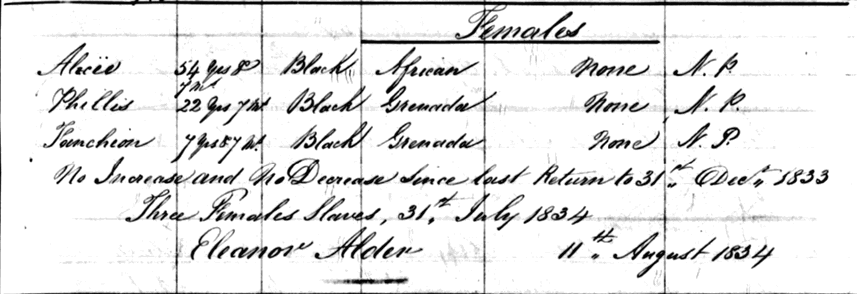
Eleanor Alder was based in St George’s, Grenada. She depended on the labour of three Black enslaved women to run her small household. Though illiterate and far from wealthy, she actively participated in the enslavement system, to sustain her daily life.

Fact File:     Eleanor Alder 

Claim Number: 156 

Compensation Award:  £61 18s 6d 

Number of Enslaved in Claim: 3 

Parish: St. George 

Parliamentary Papers: p. 95 

------------------------------------------------------------------------- 

Eleanor Alder

 Eleanor Alder appears in the Grenada compensation records as a small-scale enslaver who was based in the parish of St George and held three enslaved people at the time of emancipation. She submitted Claim No. 156 and received £61 18s 6d when slavery was abolished, an amount reflecting both the limited size of her holding and the intimate household-based nature of her reliance on enslaved labour. She would have held the enslaved to work in her household, in a business or even rented their services out.  In any event, records suggest a woman of modest means, and her own signature in the Slave Registers was a simple cross which indicates that she was illiterate. This detail offers a glimpse into her social position: a woman who occupied authority over others while lacking the literacy and formal education that many plantation and business proprietors possessed. So, it is most likely she used the enslaved for her own purposes. 

It would seem that Eleanor depended on just two enslaved women to keep her household running, Elsey (sometimes called Alice) and Phillis, with the addition of Mary Louise until she was sold to Lawrence Von Weiller in 1821. It was a small group, but their hard work was what kept everything going. They almost certainly were working within a domestic capacity rather than in a field-based plantation setting.   Eleanor’s daily life and social standing were shaped by their constant presence and work. Their labour would have included cooking, cleaning, carrying water and tending to the house. 

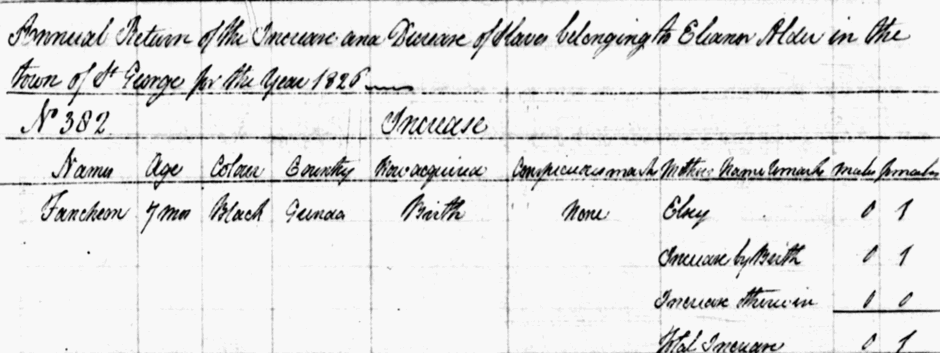
The registers show that Eleanor managed a shifting enslaved household across nearly two decades of reporting, selling Mary Louis in 1821 and recording the birth of Fancheon to Elsey in 1826. These transactions reveal how even small-scale enslavers used sale, purchase, and reproduction as mechanisms for maintaining their labour force. By 1834, on the eve of full emancipation, Eleanor Alder still held three enslaved persons; an adult woman approaching old age, a young woman at the height of her strength, and a child whose lives and relationships had become deeply entwined with the rhythms of her household. Her story, though modest in scale, forms part of the wider picture of small female enslavers in Grenada whose domestic settings were nonetheless sustained by exploitation, and the legal ownership of other human beings.


What was Eleanor’s racial identity?

We have found no record that explicitly states Eleanor Alder’s colour or racial identity. However, when we place all the available evidence side by side and consider the social structure of early-nineteenth-century Grenada, one conclusion becomes significantly more likely than the others.  She was most likely white.

Several factors support this interpretation.

  • She owned multiple enslaved women.
  • She was illiterate and signed the registers singularly herself. From this, we can assume that she was the head of the house (there is no record of her marital status). She may have inherited the means to acquire the workers from a former spouse or other inheritance.
  • She traded with a white man for the sale of Mary Louise.

That said, “free coloured” in St George did own small numbers of enslaved people, and illiteracy was not uncommon among them. However, this occurred less often before the 1830s and there would be other clues to ethnicity in parish or manumission records, none of which have surfaced for Eleanor.

Also, a formerly enslaved and single woman owning multiple enslaved women herself was less common.  Although, it must be remembered that many of these women had "relationships" with white men who may have provided the means to own property, including enslaved Still, nothing in the registers suggests that Eleanor had recently transitioned from enslavement to freedom, and socially she operated firmly within the enslavement system.

 ------------------------------------------------------------------------- .
The Enslaved

Records from the Slave Registers by year 

 
Key: B = Born, P = Present, S = Sold 

The people Eleanor Alder enslaved; Elsey (also recorded as Alice), Mary Louis, Phillis, and Elsey’s daughter Fancheon, form a small but emotionally powerful enslaved community shaped by intergenerational bonds, forced labour, and the insecurity of sale and separation. Their stories, as recovered from the Slave Registers, reveal the intimate scale of domestic enslavement in Grenada and the resilience of women who lived through displacement, childbirth, and the unrelenting control of an owner’s household.


Elsey and Fancheon

Elsey, born in Africa between 1777 and 1780, was the anchor of this enslaved group. By the time she first appeared in the 1817 register she was already a mature woman, forcibly removed from her homeland decades earlier and likely carrying memories of her original language, culture, and family. Over the years she was consistently recorded, always present, always serving suggesting that she was Eleanor’s most relied-upon worker. Late in life, in 1826, she gave birth to her daughter, Fancheon, showing both the exploitation of enslaved women’s reproductive bodies and the strength of a woman who became a mother again in her late forties.

Fancheon grew up entirely within the confines of the Alder’s affairs, her earliest years spent in servitude and likely shadowing her mother’s tasks within the household.

Fancheon was recorded from infancy through to age eight during the final years of slavery. Born into a system already beginning to collapse, she represented the last generation of enslaved children under Alder’s control. Her early years were shaped by her mother Elsey’s labour and by the enforced intimacy of a tiny enslaved household where the boundary between childhood and servitude was thin and shifting.


Who was Fancheon’s father?

Records do not name Fancheon’s father, but several clues help us understand what is most likely. Fancheon was born in March 1826 to Elsey, an African-born woman in her late forties. Both mother and daughter were recorded as Black, and there were no enslaved men listed on Eleanor’s property at that time. This means that Fancheon’s father cannot have been an enslaved man belonging to Eleanor, since her small household consisted only of enslaved women. The father must therefore have come from outside of this setting.

In early nineteenth-century Grenada, when a small domestic enslaved household contained only women, the majority of children born under these circumstances were fathered by free men living or working nearby. These men were most commonly white or free coloured and had social, economic, or physical access to the household. In an environment where enslaved women had no legal rights over their bodies and were routinely exposed to coercion, such paternity was seldom the result of an equal or consensual relationship. Elsey’s advanced age at the time of Fancheon’s birth strengthens this interpretation.

It is possible that the father was an enslaved man from a neighbouring urban household, since Eleanor lived in St George’s where domestic properties stood close together. Enslaved men working as grooms, tradesmen, or hired labourers often moved between properties. However, African-born enslaved women in their late forties rarely entered consensual relationships with enslaved men, especially when no enslaved men were present in their immediate domestic environment. Pregnancies at this age were far more often the result of sexual exploitation by free men with authority or proximity.

The social realities of Grenada at the time strongly suggest that the father was a man from outside the household, very likely a free man who had the power to exploit Elsey’s position.


Phillis

Phillis, born in Grenada in 1813, grew into adolescence and adulthood while still enslaved by Eleanor Alder. By the time emancipation arrived in 1834 she was twenty-one and would have been indispensable to the household’s labour.

The surviving registers do not explicitly identify her mother, but the available evidence allows us to make a strong and well-reasoned assessment. Phillis appears consistently on Eleanor Alder’s property from 1817 through to emancipation. At the time of her birth, the only African-born women under Alder’s control were Elsey and Mary Louise. Both women were of childbearing age in 1813, making either a possible mother. Elsey would have been in her mid-thirties, while Mary Louise would have been around twenty-two.

It is also possible that she was bought as a child before she reached 4 years old.

The relationship between Phillis and the other enslaved women offers important clues. Phillis remained with Elsey across every slave register, through changes in ownership and household structure. When Mary Louise was sold to Lawrence Von Weiller in 1821, Phillis did not accompany her. In small domestic enslaved households like Eleanor Alder’s, mothers and young children were generally kept together unless a deliberate decision was made to separate them. The fact that Phillis stayed while Mary Louise was removed suggests that they were not regarded as a mother-and-child pair. In contrast, Phillis grew into adulthood alongside Elsey and later with Fancheon, forming the kind of intergenerational domestic unit characteristic of enslaved family groups centred on a matriarch.

Elsey’s later childbirth further strengthens the likelihood that she was Phillis’s mother and may have been fathered by the same man.


Marie Louise: From Africa to Emancipation – A Life Traced Through the Registers

Mary Louis, also born in Africa suggested around 1791 (there are no records to confirm the date of birth). She appears in the 1817 register as a young woman in her twenties, sharing with Elsey the experience of forced migration and loss. Her life took a different path in 1821 when she was sold to Lawrence Von Weiller, a transaction that demonstrates how easily family-like bonds within small enslaved households could be broken. It is possible that she was the mother of Phillis, who appears as a young Grenadian-born girl in the registers, though it is more likely that Phillis was Elsey’s child.

Marie Louise’s life is one of the rare stories we can follow across more than two decades of Grenada’s slave registers. She was an African woman whose presence is recorded with remarkable consistency from 1821 through to emancipation in 1834. Her life reveals the instability of enslavement, the emotional and physical endurance of African-born women, and the shifting household fortunes that shaped the fate of the enslaved.

Early Life and Sale in 1821

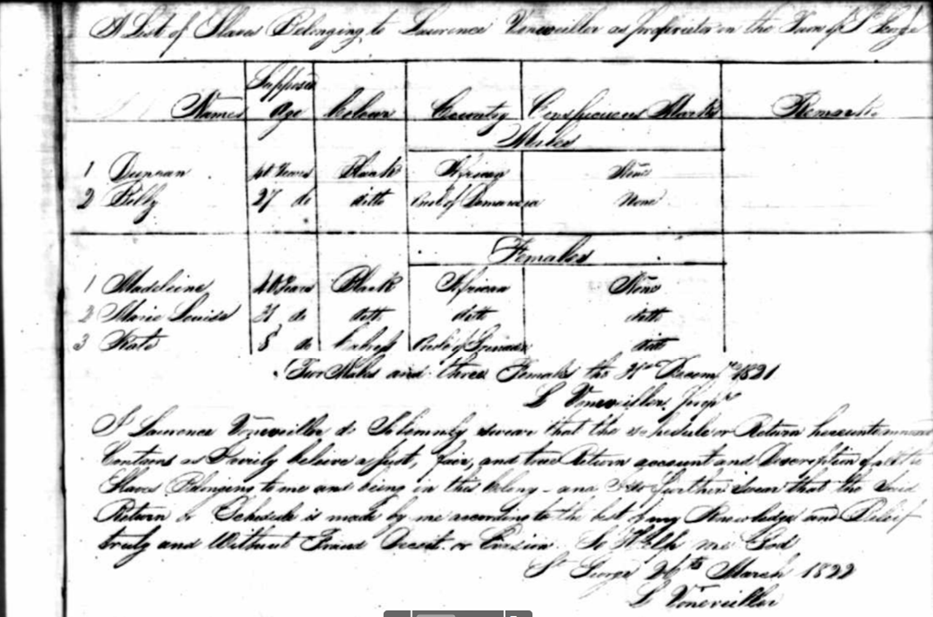
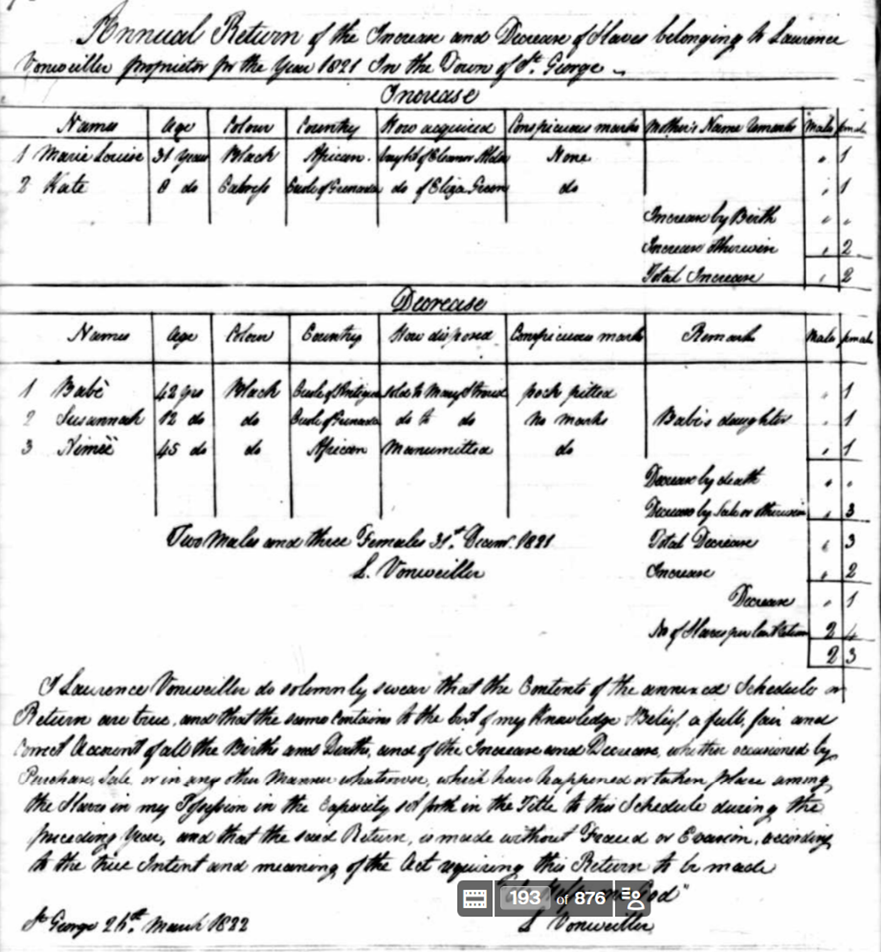
Marie Louise was forcibly transported from Africa to Grenada during the later years of the slave trade. By 1821, aged about 31, she was enslaved by Eleanor Alder, living in a small domestic household where she worked alongside one or two other enslaved women. That year, Eleanor sold her to Lawrence Von Weiller, a transaction that uprooted her from a familiar yet coercive environment and relocated her into the domestic orbit of a new enslaver at a pivotal moment. 

  • Note: Lawrence Von Weiller was a free coloured man of mixed African and French heritage. He was charged but pleaded and was found not guilty for his involvement in Fedon's Rebellion 1795-1976 and was discharged. He was one of those who had surrendered. He owned a plantation in St Andrew.

Here, she joined Duncan and Madeline also from Africa, both aged about 40, Billy (27) from Demarara and a mixed race girl called Kate (5) who was born in Grenada.


1821 is also the year when Lawrence Von Weiller manumitted a 45 black African woman called Nimee. For Marie Louise, this must have been a moment of mixed significance. On the one hand, entering a household where manumissions occurred may have offered some hope of being released at some stage. On the other, she may just have been a replacement for Nimee. Whatever its meaning, this episode places her life at the intersection of hope and pragmatic exploitation.


Transferred by Will After Lawrence’s Death (1825)

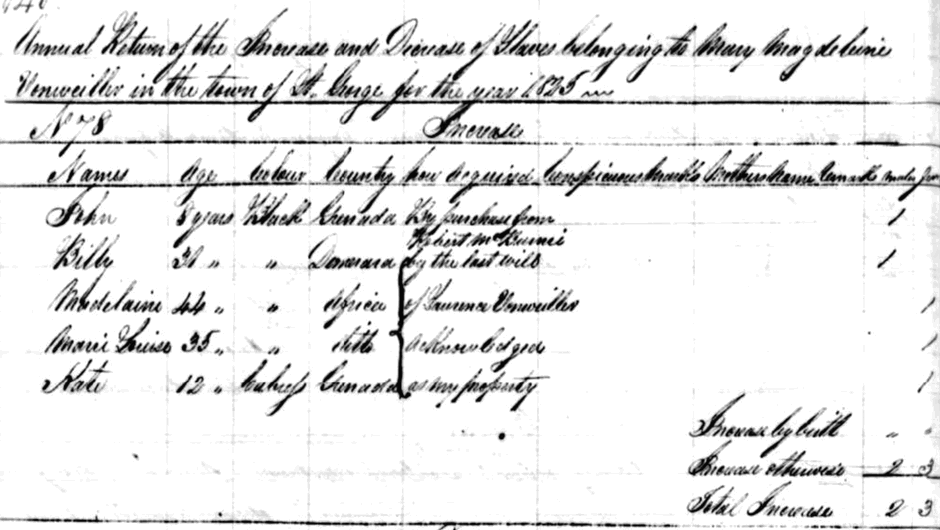
By the 1825 Slave Register, Lawrence had died. Marie Louise, then aged 35, was inherited by Mary Magdeleine Von Weiller, likely Lawrence’s widow or daughter.She was bequeathed to Magdeleine together with Billy (31), Madelaine (44) and Kate (12), who she knew from her time with Lawrence. She was also joined by John (8) who had been purchased from Robert McBurnie.

This very act of being willed as property and having to move without choice illustrates the brutal legal reality governing her life. Even in death, enslavers retained the right to direct the future of the enslaved, severing them from potential manumission and re-embedding them into new authority structures without their consent.


The 1829 Slave Register records Marie Louise again, this time aged 39, still owned by Mary Magdalene together with Madeleine and Kate

The three appear to have formed a small, stable domestic unit. Their ages and origins suggest a multigenerational household: two African-born women in mature adulthood and one younger Grenadian-born girl entering her mid-teens. The fact that there were no increases or decreases from the last register in Mary Magdalene’s household would indicate that John and Billy left soon after they were acquired. Still Enslaved in 1834: The Final Register Before Emancipation


The 1834 register, the last before full emancipation, lists Marie Louise again, now aged 43½ years. Madeleine (32½) and Kate (20) were still there too, forming a tight-knit trio whose lives had become deeply intertwined after years of shared forced labour.

To be recorded in 1834 means Marie Louise lived to see the legal end of chattel slavery in Grenada. She entered the island as an enslaved African girl or young woman and survived into the new era of apprenticeship. This is an extraordinary arc of endurance for someone who had already survived the Atlantic crossing, sale, inheritance, and decades of coerced labour.


What This Reveals About Her Experience

  • Marie Louise’s life story, reconstructed from careful archival tracing, becomes a powerful testament to the lived experience of African-born women who endured and adapted across major transitions:
  • She survived the Middle Passage.
  • She was sold at least once, inherited once, and never freed before 1834.
  • She lived in three consecutive enslavers’ households.
  • She forged long-standing bonds with other enslaved women, especially Madeleine and Kate.
  • She remained stable in one household long enough to reach emancipation alive

This was a remarkable outcome given the mortality rates for African-born enslaved people. Her story, preserved across multiple returns, gives us one of the clearest examples of an African-born Grenadian enslaved woman whose life spanned the system’s final decades and ended in the moment of its collapse.


Summary

Although Eleanor Alder was neither wealthy nor part of the large planter class, her possession of three enslaved women makes sense once we consider the nature of labour in domestic settings in early nineteenth-century Grenada. Households like hers relied entirely on human labour for every aspect of daily life. Enslaved women performed a wide range of tasks that today would be divided among several occupations, and their roles were physically demanding, continuous, and often required overlapping skills and constant availability.

A single householder, especially an illiterate woman without a husband—depended on enslaved women to run her entire domestic world. Household labour included cooking over open fires, washing clothes by hand, fetching large quantities of water (as there were no pumps in most domestic settings), cleaning, tending small gardens or kitchen plots, preserving food, carrying goods to market, and sometimes producing items for sale. In addition, enslaved women cared for livestock, fetched firewood, and assisted with small-scale agricultural tasks if the property had provision grounds or cash crops. A lone enslaved woman could not reasonably sustain all of this work, particularly as many tasks had to be done simultaneously.

Age was another factor. Elsey, the African-born woman under Alder’s control, was already in her late thirties or early forties when the registers began and later reached nearly fifty. Older enslaved women were usually the most experienced and trustworthy, but physically they could no longer shoulder the heaviest work alone. Eleanor would have required a younger woman, such as Phillis, to take on strenuous duties. When Phillis was a child, Eleanor still required a second adult, which explains the presence of Mary Louise in the early years. In small households, enslaved children could not contribute meaningfully until they were older, making an additional adult woman necessary to maintain day-to-day operations.

Domestic settings also needed continuity. Illness, pregnancy, or injury could leave a household without labour, so enslavers often kept two or three women to ensure that essential work continued uninterrupted. With no enslaved men under Alder’s control, the women may also have been responsible for tasks that mixed-gender enslaved households usually shared. In this sense, the three women functioned as a complete labour unit: one older, experienced matriarch; one younger woman becoming the main labourer; and, eventually, a child growing into work roles as she matured.

Finally, the presence of three enslaved women reflects the social expectations of the time. Even modest white women in St George often owned multiple enslaved people because it was seen as a marker of respectability. Domestic labour was not only a necessity but also a symbol of status. Eleanor’s reliance on enslaved women allowed her to sustain the appearance and functioning of her interests, even if she herself lacked literacy, wealth, or broader social power.

Together, the enslaved workers under Eleanor Alder’s control formed a small but resilient community. There were African-born elders holding memory and trauma, Grenadian-born daughters inheriting both burden and strength. Their labour sustained the Alder household, their relationships gave them emotional survival, and their presence reveals how even small households were sites of coercion but also endurance, and intergenerational resilience.


References

Slave Registers for Eleanor Alder from 1817, 1821, 1825, 1826, 1831, 1833, 1834

Slave Registers for Lawrence Vonweiller from 1821 (and another from the same year)

Slave Registers for Magdelaine Vonweiller from 1825