Elizabeth Alvarez
Fact File:
Name of Claimant Elizabeth Alvarez
Claim Number: 87
Compensation: £20 12s 10d-
Number of Enslaved in Claim: 2
Parish: St George
Parliamentary Papers: P.95
-------------------------------------------------------------------------
Family
Little is known about Elizabeth’s background. Her surname and claimant profile strongly suggest Iberian-Spanish heritage, most plausibly originating in Venezuela and transmitted through Trinidad following the British capture of the island in 1797. Trinidad functioned as a cultural and legal bridge for Spanish-speaking Catholic families, enabling their onward migration into Grenada. It is interesting to note that while no records can be found for her, there might be some links to her family. Festus Augustus Alvarez was born 19 September 1867 to John and Catherine Alvarez in St John.
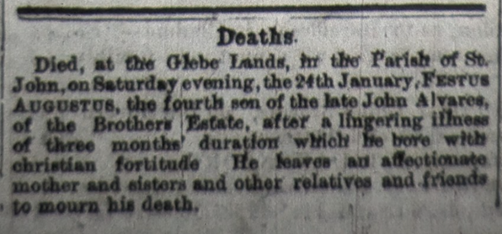
His death notice published in St Georges Chronicle and Grenada Gazette 31 January 1891 recorded that he was one of the 4 sons of John Alvarez and that he had sisters as well. It also stated that John was from the Brothers Estate, St John.
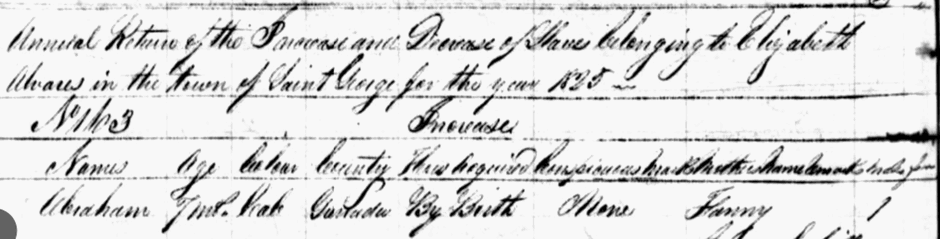
Elizabeth had a small holding in St George where she kept a black enslaved woman called Fanny from 1821. Fanny had 2 children whilst under her control, Pomelia in 1823 and Abraham in 1825. Both were fathered by a white man.
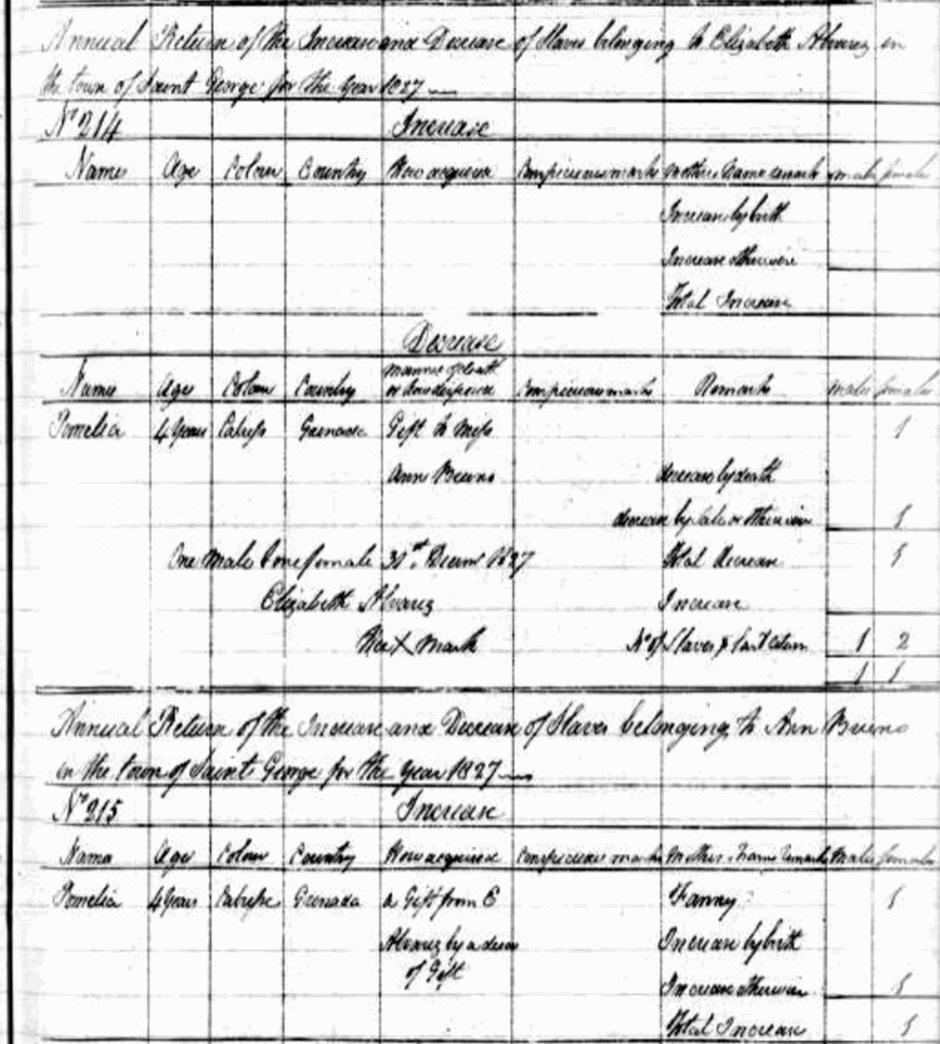
Elizabeth gave Pomelia away as a gift to Miss Ann Burns when she was 4 years old in 1827 separating her from her mother and brother.
Elizabeth also acted as an agent for Lydia BEATTIE in 1830. In this capacity she gifted a 10 year old boy, Robin, from Barbados, to Daniel CAMPBELL.

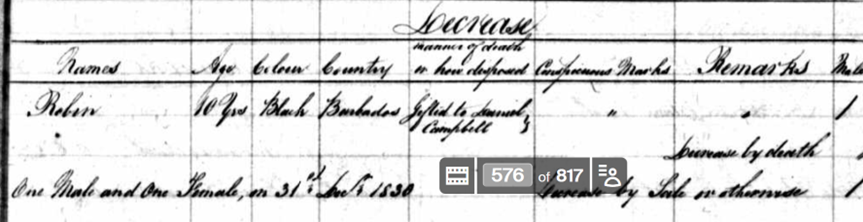
Lydia bought him back the following year.
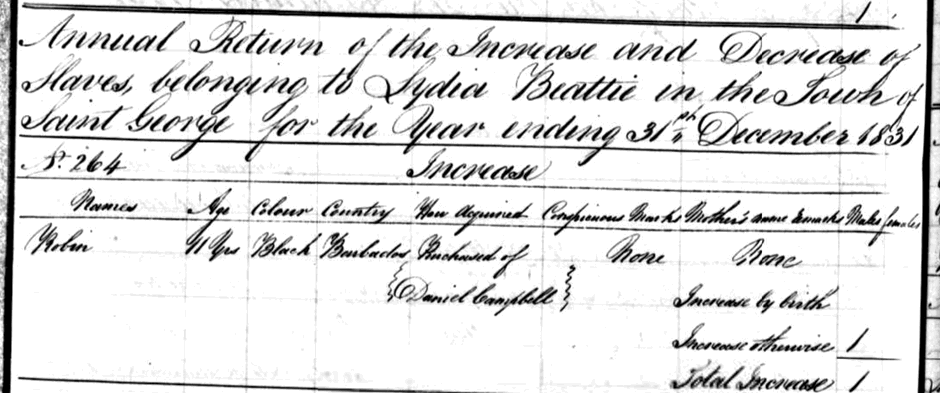
Robin stayed with her up to the last slave register of 1834.
Compensation Claim (Grenada No. 87)
On 5 October 1835, Elizabeth Alvarez submitted an uncontested claim for compensation under the provisions of the Slavery Abolition Act, recorded in the Parliamentary Papers for Grenada. Her claim related to the legal ownership of Fanny and Abraham, for which she received £41 5s 8d in compensation.
Although modest in scale when compared to the large plantation claims that dominated Grenada’s compensation landscape, Elizabeth Alvarez’s award is significant for what it reveals about the breadth of slave ownership on the island. Claims such as hers demonstrate that enslaved people were held not only on major estates but also within small household or personal holdings, often by individuals whose wealth and status were far removed from the absentee planter elite.
The records list Elizabeth Alvarez as the sole claimant, with no named co-claimants or trustees. The absence of associated estates suggests that the enslaved individuals were likely held outside the framework of a large plantation, possibly in a domestic, artisanal, or small-scale agricultural context.
Elizabeth Alvarez reflects the British state’s decision to recognise financial loss to enslavers, while offering no compensation, land, or material support to the formerly enslaved themselves.
Elizabeth Alvarez’s claim therefore forms part of the wider Grenadian compensation record that exposes the everyday normalisation of slavery across social classes. Her case reminds us that the system was sustained at all levels from powerful plantation families through to smaller, more intimate forms of ownership that embedded slavery deeply within domestic and social life on the island.
The Enslaved
Slave Registers

Fanny
Fanny first appears in the Slave Register of 1821 under Elizabeth’s control. She was not new to this ownership but her prior history is not known. She had 2 children: Pomelia in 1823 and Abraham in 1825. They are described as Cabresse and Cabre which is the term used for having being the child of a black person and a mulatto. It would appear, in this case that the father was a mulatto.
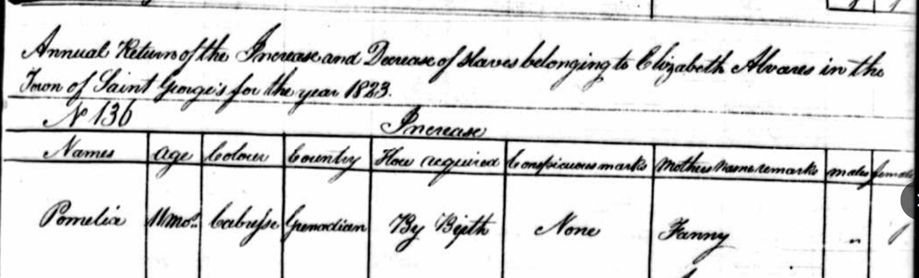
For some reason, Pomelia was handed to Ann Burns in 1827 as a gift at the age of 4. This effectively broke the Fanny’s family unit.
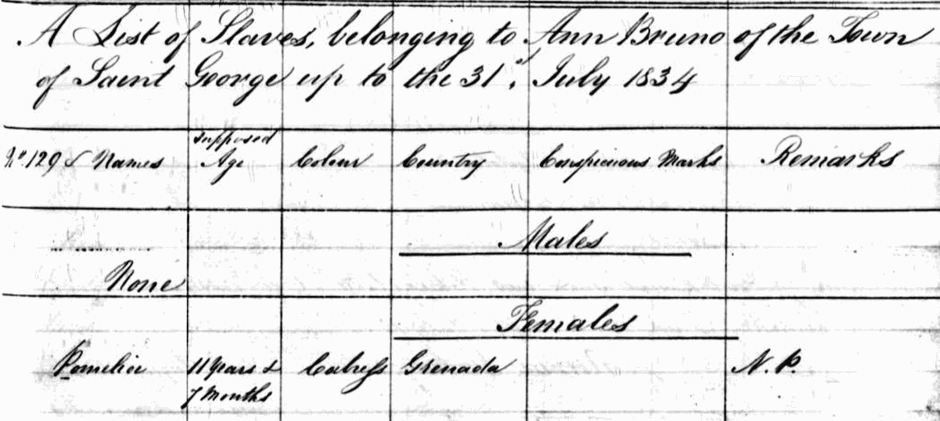
Pomelia stayed with Ann up to 1834 as the only enslaved person under her control. She was almost 12 at this time and most likely stayed with Ann until emancipation in 1838.
When abolition came, Elizabeth recorded ownership of Fanny and Abraham aged around 37 and 10 respectively.
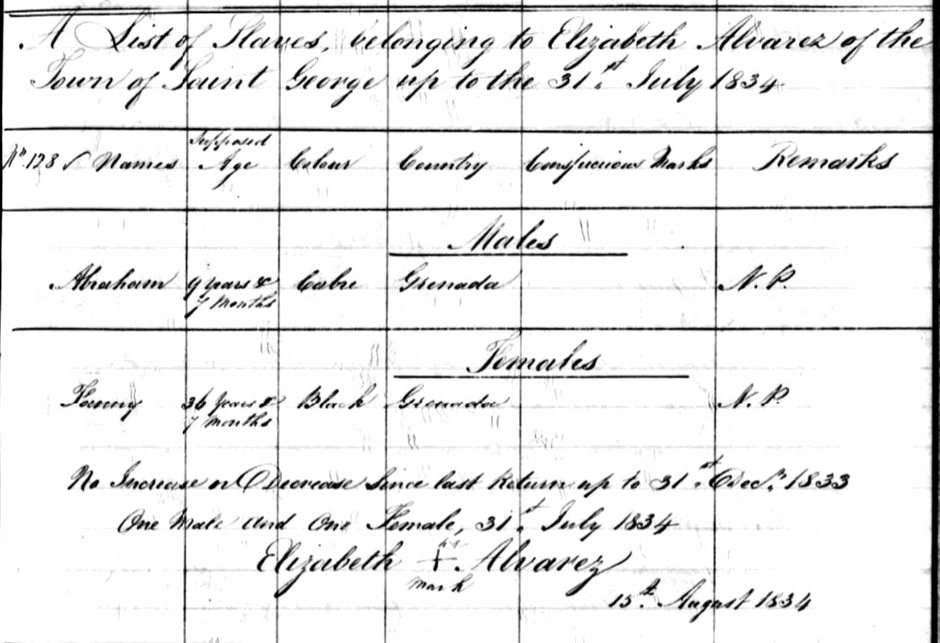
Emancipation would follow 4 years later. Could this see a family reunion with Pomelia?
-------------------------------------------------------------------------
Acknowledgements
We are grateful to Dr. John Angus Martin of the Grenada Genealogical and Historical Society Facebook group for his editorial support.
-------------------------------------------------------------------------
References
Festus Augustus Alvarez birth record "Grenada, Church Records, 1747-1930", FamilySearch (https://www.familysearch.org/ark:/61903/1:1:6KSH-SPD3 : Sat Mar 09 01:59:17 UTC 2024)